Tag: Bad Faith

  • Arson Investigations: Best Practices for Establishing Fraud and Avoiding Bad Faith

    Arson Investigations: Best Practices for Establishing Fraud and Avoiding Bad Faith

    Emerging Litigation Podcast

    Emerging Litigation PodcastProduced by HB Litigation

    Interviews with leading attorneys and other subject matter experts on new twists in the law and how the law is responding to new twists in the world.

    Interested in contributing an article? Email us at Editor@LitigationConferences.com.

    Arson Investigations

    Best Practices for Establishing Fraud and Avoiding Bad Faith 

    By: Melissa A. Segel

    Diligent claim handling means using all resources that the policy and applicable law provides while allowing inherent curiosity to lead to the proper legal and ethical conclusion.

    It has been decades since arson was graduated from a mere property crime to an economic crime, one that triggers many billions of dollars’ worth of fraudulent claims each year. Fortunately, the technologies available to investigate these pervasive criminal acts have evolved as well. When handling fire damage claims, however, the duties of insurance companies and best practices to mitigate risk remain as important as ever. 

    In 1979, the U.S. Senate conducted a study on the role of the insurance industry in dealing with arson for profit, noting the industry’s estimate of arson payouts for just one year, 1977, was $1.6 billion. That would be more than $8 billion today.  

    In 1980, the Bureau of Alcohol, Tobacco, Firearms and Explosives (ATF) ranked arson for profit among the nation’s fastest-growing crimes.  

    It was in 1996 that firefighting information service, Firehouse, declared that setting fires had evolved from a property crime into an “economic crime used to extort money from insurance companies.”  

    By 1998, property loss resulting from arson exceeded $3 billion ($7.5 billion in today’s money).  

    From 2014 to 2023 dollar-value losses due to residential arson increased by 26%.  

    In 2023, ATF estimated that 25% of all fires reported were due to arson.  

    Arsonists don’t just target buildings and structures. The Coalition Against Insurance Fraud reports that in 2020 nearly 9,000 car fires in the U.S. were set by arsonists.  

    Finding that arson was not only a serious economic crime but a blight on society, the recommendations that came out of the 1979 Senate investigation included a focus on underwriting practices, urging insurance carriers to develop systems to detect suspicious fires and encouraging the modification of privacy and fair claims practices laws.  

    It remains important today for insurance carriers to develop resources to protect themselves from this pervasive economic crime with prompt investigations, good faith claims handling, and vigorous defenses. Insurance carriers and their experts must stay up to date on the latest tools and technology available, including the use of artificial intelligence (AI), 3D scanning, mapping software, drone imaging and accelerant detection, alongside the tried-and-true methodologies such as canine alerts from trained arson dogs.  

    Establishing Arson Fraud 

    Typically, insurance companies do not file suit against their insureds for arson, instead choosing to deny and defend the claim without taking an affirmative action. If an insured files suit and the insurance company asserts an arson defense, East Park, Inc. v. Federal Insurance Co. (794 F.2d 616, 618–19 (11th Cir. 1986)) established that the defense must provide evidence that: (1) the fire was of incendiary origin, (2) the insured had the motive to have the fire set, and (3) either the insured had the opportunity to have the fire set or unexplained surrounding circumstantial evidence implicate the insured. Essentially, “evidence of incendiary origin and motive by themselves are not sufficient to establish an arson defense; there must be in addition some evidence which would link the suspect to the arson.” Georgia case law, based on Blackwell v. American Southern Ins. Co. (121 Ga. App. 671, 672 (1970)), also will not permit an insured to recover under a policy if a preponderance of credible evidence (direct or circumstantial) establishes that a loss was intentional and that an insured was involved in causing or procuring a loss.  

    Key elements for success in an arson fraud case include a prompt and thorough on-site investigation to establish that the fire was the result of an intentional human act, detailed witness interviews, and gathering admissible evidence to establish motive and opportunity. Insurance carriers should not rely on responding firefighters to establish that the fire was incendiary. Instead, once red flags are identified, insurance carriers should retain a qualified and independent origin and cause investigator to conduct a scene inspection and be prepared to testify and present evidence of their findings in court. Just as insurance carriers need to utilize new technology, origin and cause experts must as well. The NFPA 921 Guide for Fire and Explosion Investigations, widely recognized as the fire investigation “bible,” now includes updates on fire patterns, arc mapping and fire classification. Photographs and video tell a compelling story.  

    Claim representatives should also conduct prompt witness interviews, including of the insureds, but certainly should not leave out a thorough examination under oath (EUO) of the insured(s). An EUO is typically taken by legal counsel and is critical because unlike a recorded statement, an EUO can be useful as impeachment evidence should the matter go to trial. An EUO also gives insurance carriers earlier and broader access to information than a deposition. One example of the benefits of an EUO is that an insured may not invoke legal privileges, even the fifth amendment right against self-incrimination. Harary v. Allstate Ins. Co., 988 F. Supp. 93, 103 (E.D.N.Y. 1997), aff’d, 162 F.3d 1147 (2d Cir. 1998) (an insured may not use her Fifth Amendment privilege as a sword against her fire insurer); Pervis v. State Farm Fire and Cas. Co., 901 F.2d 944 (11th Cir. 1998) (holding that the fifth amendment privilege against self-incrimination did not excuse the insured from fulfilling his contractual obligation to answer questions that were material to insurer’s investigation during examination under oath). 

    Utilizing the resources of the policy’s cooperation requirements, insurance carriers should also demand that the insured fully cooperate and produce critical and relevant records and documents. This evidence can then be used to establish that the insured had both the motive and the opportunity to set the fire. Collected items should include activity records, such as phone records and social media posts, financial records showing income and expenditures, and documentation to support ownership of the items claimed. It is important to keep in mind that if an insured fails to cooperate, that in and of itself can provide the insurance carrier with an affirmative defense. Halcome v. Cincinnati Ins. Co., 254 Ga. 742, 344 S.E.2d 155 (1985); Allstate Ins. Co. v. Hamler, 247 Ga. App. 574, 545 S.E.2d 12 (2001); Diamonds & Denims v. First of Ga. Ins. Co., 203 Ga. App. 681, 417 S.E.2d 440 (1992).  

    Lawsuits and Bad Faith  

    If an insured files suit after a claim is denied for arson, pretrial discovery plays a critical role in uncovering fraud since the determination of whether an insurer’s decision was made in bad faith depends upon the sufficiency of its evidence in court, not the information it had at the time the claim was denied. Attorneys should seek legally credible and reliable copies of all documents used for the arson and fraud defense to ensure the records will be admissible in litigation. This includes getting certified copies of those phone records and bank statements secured in the preliminary investigation. It is important to document the claim file thoroughly with as much information as possible but also to understand that certain information may require a subpoena to be obtained from other sources if the claim progresses into litigation.  

    In order to avoid bad faith and potential extra-contractual penalties in this current litigious environment, insurance claim professionals must conduct their claim investigations while considering regulatory requirements, case law and industry standards, along with the potential legal ramifications for failing to adequately investigate suspicious claims. Most states have an unfair claims practices act or similar statute that penalizes insurance carriers who unreasonably fail to settle covered claims. See e.g. Georgia statutes O.C.G.A. §§ 33-4-6, 33-4-7. It is important to stay up to date on relevant state laws, both statutory and common law, to ensure compliance with processes and time limits. 

    Keep in mind that most states require an insurer to satisfy not only the bad faith statute’s procedural requirements but also its substantive requirements. For example, under Georgia law, there can be no finding of bad faith under O.C.G.A. § 33-4-6 if “it can be said as a matter of law that there was a reasonable defense which vindicates the good faith of the insurer,” and that “the insurer had reasonable and probable cause for making a defense to the claim.” Colonial Life & Accident Ins. Co. v. McClain, 243 Ga. 263, 265 (1979). Additionally, with no statutory definition of “bad faith,” Georgia courts have defined it as a “frivolous and unfounded refusal in law or in fact” to provide coverage according to the terms of the policy. See e.g. Interstate Life & Accident Ins. Co. v. Williamson, 220 Ga. 323 (1964). Furthermore, whether the insurer’s denial was “frivolous or unfounded” is determined based on the evidence presented at trial, not at the time the claim decision was made. Hudson v. State Farm Mut. Auto. Ins. Co., 201 Ga App. 351 (1991). 

    Investigating and Reporting Arson Fraud 

    While conducting thorough investigations to root out arson, carriers also must consider the potential exposure for failing to investigate claims, whether based upon a cost-benefit analysis or upon some urgency in processing claims, such as during a catastrophe. Arson and insurance fraud are crimes in every state. Many states have insurance fraud bureaus or departments that investigate illegal insurance activities (whether by carriers or by policyholders).  

    Several states require insurance carriers to have mandatory fraud plans and report insurance fraud when discovered. Many states have enacted legislation requiring insurance companies to notify law enforcement authorities when arson or fraud is suspected and to cooperate in third-party governmental investigations of arson and fraud claims while giving immunity from criminal or civil prosecution for such cooperation. See e.g. Georgia: O.C.G.A. §§ 25-2-33, 33-1-16; Florida: Fla. Stat. §§ 633.126, 626.989; Illinois: 215 ILCS 145/1, 215 ILCS 5/155.24; Michigan: MCLS §§ 29.4, 500.4509. However, such immunity from criminal and civil liability is often limited to insurance carriers who cooperate and report in good faith in the investigation of suspected arson and fraud.  

    Investigating arson and fraud is, in many states, an insurer’s obligation. “An insurance company has a ‘responsibility to marshal all … facts’ necessary to make a determination as to coverage ‘before its refusal to pay.’” Jones v. Alfa Mut. Ins. Co., 1 So. 3d 23, 36 (Ala. 2008) quoting Aetna Life Insurance Co. v. Lavoie, 505 So.2d 1050, (Ala.1987) (finding the question of bad faith could go to a jury when the evidence showed that the carrier failed to investigate the pre-loss condition of the house). 

    Insurance carriers should then follow the requirements of their respective state laws in releasing information to the authorized official, whether the state fire marshal, insurance commissioner or other law enforcement agency. For example, in Georgia, O.C.G.A. § 33-1-16 requires an insurer to comply with requests for information from the insurance commissioner and the commissioner’s investigative agents but does not provide a specific definition identifying the appropriate law enforcement authorities to whom an insurer may release information. Instead, the statute generally identifies qualified law enforcement agencies as any federal, state, county or consolidated police or law enforcement departments and any prosecutors or district attorneys. Thus, the list of individuals to whom insurance carriers may or are obligated to release information appears very broad.  

    Consequently, there is seemingly no limit on the number of governmental investigative agencies to which an insurer should produce its claims file. As such, for those insurance carriers who wish to rely upon the statute in reporting suspected arson or fraud to law enforcement authorities, it would probably be beneficial to narrowly construe the statute when providing information voluntarily.  

    In other words, if there is a question as to the propriety of voluntarily releasing information to a particular public authority not listed in the statute, the insurer should err on the side of caution and not voluntarily release that information.  

    Although certainly not a new problem, arson continues to be an ongoing concern for insurance companies. Diligent claim handling means using all resources that the policy and applicable law provides while allowing inherent curiosity to lead to the proper legal and ethical conclusion. 

    Key Takeaways

    • Arson is a serious economic crime that impacts society, necessitating robust underwriting practices in the insurance industry.

    • Insurance companies should utilize modern technology, such as AI, 3D scanning, drone imaging, and accelerant detection, to investigate suspicious fires.

    • Establishing an arson fraud case requires proving the fire’s incendiary origin, the insured’s motive, and their opportunity to set the fire.

    • Insurance carriers should promptly conduct thorough on-site investigations and witness interviews, including examinations under oath (EUO).

    • Failure of the insured to cooperate in the investigation can provide the insurance carrier with an affirmative defense.

    • Insurance carriers must adhere to regulatory requirements, case law, and industry standards to avoid bad faith and extra-contractual penalties.

    • Most states have laws requiring insurance companies to report suspected arson and fraud, with immunity often granted for good faith cooperation.

    • Thorough documentation and legally credible evidence are crucial for defending against claims of bad faith in court.


    Melissa A. Segel, a partner at Swift Currie, focuses her practice on insurance coverage matters with an emphasis on defending against bad faith and fraudulent claims, including those related to arson; automobile accidents; and theft in homeowner, business and auto insurance policies. She may be reached at melissa.segel@swiftcurrie.com. 
  • Catastrophic Wildfires Recovery – Get the Most from Your Insurance Coverage

    Catastrophic Wildfires Recovery – Get the Most from Your Insurance Coverage

    Catastrophic Wildfires Recovery – Get the Most from Your Insurance Coverage

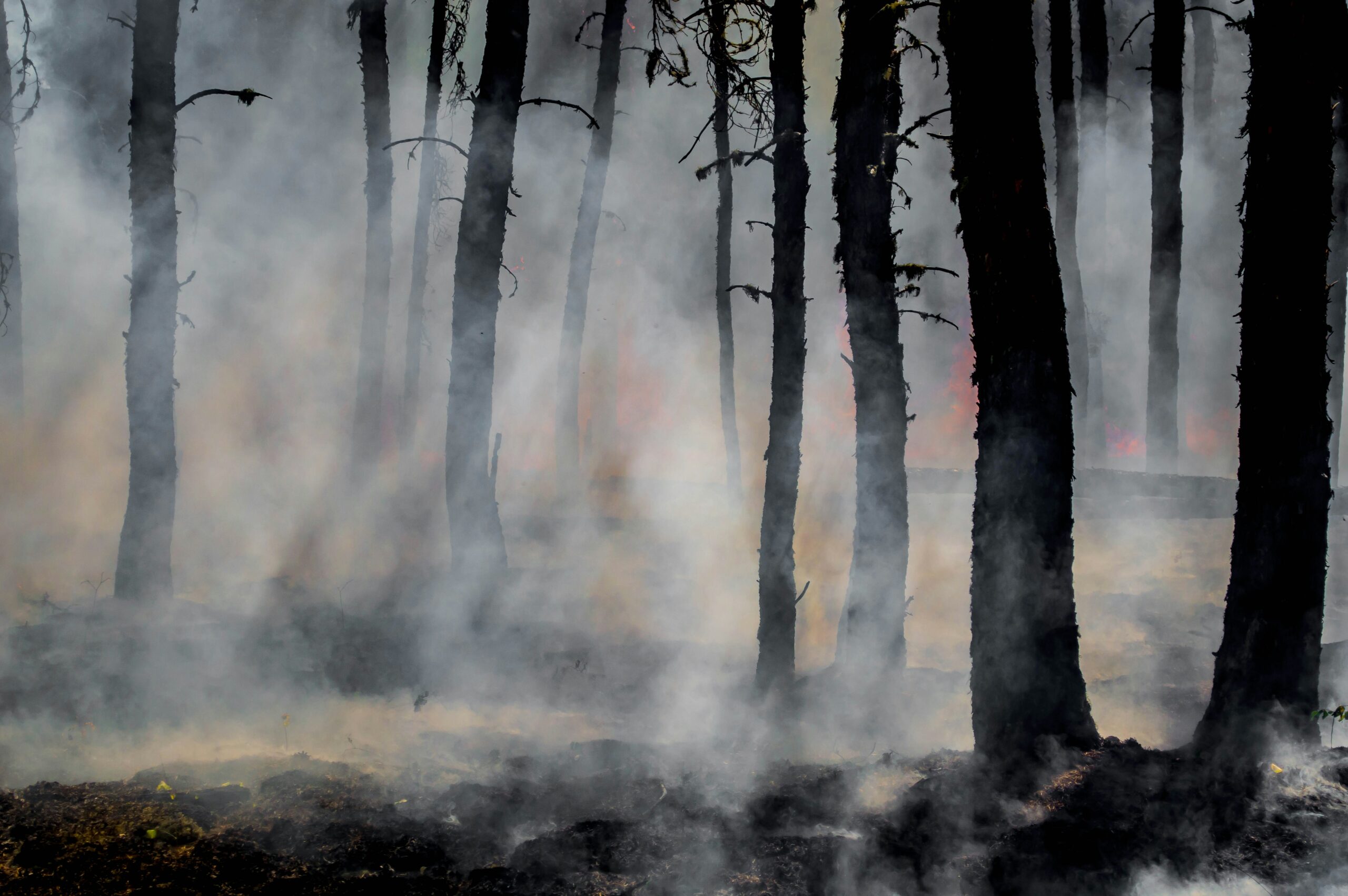
    A foggy forest landscape representing the aftermath and risk of wildfires for homeowners and businesses

    Gain an understanding of the complex insurance coverage and remediation issues arising from wildfire disasters, including property damage claims under commercial all-risk and homeowners insurance, valuation provisions like replacement cost and ACV, and time element coverages such as business income loss, civil authority coverage, and additional living expenses.

    This webinar addresses a host of insurance coverage and remediation issues stemming from the wildfire disasters. It focuses on property damage and remediation under various forms of property insurance including commercial all-risk coverage and homeowners insurance. Speakers address coverage issues involving valuation provisions such as replacement cost coverage, ACV, and ordinance and law coverage grants and limitations.  Time element coverage is also addressed as it appears in provisions promising protection for business income losses, CBI, ingress and egress coverage, service interruption, civil authority coverage, and loss of use/additional living expenses coverage

    The panel offers insights into the claims handling process, such as time sensitive clauses ranging from notice of claim to suit limitation provisions.  Claim investigation, adjustment, and forensic accounting aspects of property loss adjustment are also explained and commented on in detail. Policyholders and other stakeholders will benefit from insights on claim issues that arise in the context of largescale natural disasters, and steps policyholders – whether they are large organizations or individual homeowners – can take to position themselves for fair claim payments.  Additionally, the program outlines claim valuation and coverage dispute resolution options that may be available, as well as the potential for bad faith allegations.

    Learning Objectives

    Understand scope of coverage under commercial property and homeowners policies. Gain a clear perspective of what types of damages and losses are typically covered and time element protections for business interruption, civil authority, loss of use and other coverages that protect businesses and communities.

    Learn to assess policy limitations. Learn to identify common and misunderstood limitations in insurance policies that may affect coverage for wildfire-related claims.

    Know the recent case law. Review recent decisions that have shaped the current landscape of wildfire insurance coverage. Understand their implications for future claims.

    Gain insights to better navigate the claims process. Acquire practical tips and strategies for effectively managing and negotiating insurance claims related to wildfire damage, including documentation, communication with insurers, and dispute resolution.

    Understand how to preserve your rights. Addressing how to safeguard insurance and time sensitive fine print that is used to delay and void covered claims by the insurance industry, including notice of loss clauses, proofs of loss terms, suit limitation provisions and documenting cooperation and information flows during the claim adjustment process.

    Better comprehend loss adjustment, claim investigation and reaching fair valuations. This speaker addresses the inevitable arguments insurance companies use to limit claim payment for PD losses and time element coverages such as business interruption, civil authority, ingress/egress, and contingent business interruption coverage. Learn how to utilize these coverages to maximize recoveries after a disaster.

    Learn the value of public adjustors. This discussion will also address the efficient use of public adjustors to help policyholders prepare their claims and get a proper resolution of their reimbursement for covered losses.

    TAKE IT NOW

    Available now to CeriFi LegalEdge subscribers. Don’t subscribe? Don’t despair. Use code HB20 for 20% off. Or, HBSub20 for 20% off a full solo subscription. While supplies last.

    Speakers

    Dennis J. Artese

    Dennis J. ArteseShareholder, Anderson Kill P.C.

    Dennis Artese is a shareholder in Anderson Kill’s New York office and is chair of the firm’s Climate Change and Disaster Recovery practice group. Dennis has substantial experience in all phases of litigation, arbitration and property insurance appraisals, and has recovered hundreds of millions of dollars of insurance proceeds on behalf of policyholders in connection with a variety of property, builder’s risk, commercial general liability, umbrella and excess liability, D&O, E&O, crime, and political risk insurance claims. He earned his B.A. at the University of Connecticut and his J.D., cum laude, at St. John’s University School of Law.

    Marshall Gilinsky

    Marshall GilinskyShareholder, Anderson Kill P.C.

    Marshall Gilinsky is a shareholder at Anderson Kill’s Boston office, focusing on Insurance Recovery and Commercial Litigation. Co-chair of the firm’s Sexual Harassment and Abuse Insurance Recovery Group and Sports, Media, and Entertainment Group, Marshall has recovered hundreds of millions of dollars for clients during his 20-year career. He has represented clients on complex insurance claims related to major losses, including 9/11, Hurricane Katrina, Superstorm Sandy, and Boston’s “Big Dig.” He represents a diverse range of policyholders in high-stakes disputes. Marshall earned his B.S. from Cornell University and his J.D., with honors, from The George Washington University Law School.

    Joshua Gold

    Joshua GoldShareholder, Anderson Kill P.C.

    Joshua Gold is a shareholder in Anderson Kill’s New York office and serves as chair of the Cyber Insurance Recovery Group and co-chair of the Marine Cargo Insurance Group. He has represented numerous corporate and non-profit policyholders in various industries, with recoveries for his clients well in excess of $1.5 billion. Josh’s practice involves matters ranging from international arbitration, data security, directors and officers insurance, business income/property insurance, commercial crime insurance, admiralty, cargo, and marine insurance disputes. He earned his B.A. at the University of Massachusetts at Amherst and his J.D. at Benjamin N. Cardozo School of Law.

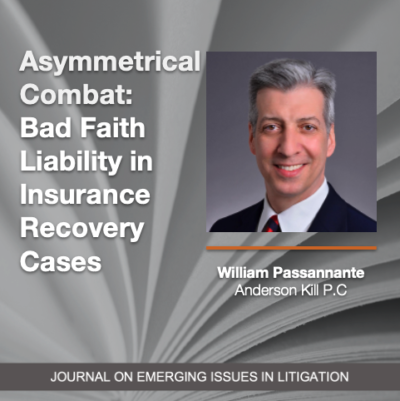
  • Asymmetrical Combat: Bad Faith Liability in Insurance Recovery Cases

    Asymmetrical Combat: Bad Faith Liability in Insurance Recovery Cases

    The Author

    William Passannante

    William PassannanteAnderson Kill P.C.

    William G. Passannante is co-chair of Anderson Kill’s Insurance Recovery Group and is a nationally recognized authority on policyholder insurance recovery in D&O, E&O, asbestos, environmental, property, food-borne illness, and other insurance disputes, with an emphasis on insurance recovery for corporate policyholders and educational and governmental institutions.

    The Journal on Emerging Issues in Litigation

    Emerging Litigation Podcast

    Emerging Litigation PodcastProduced by HB Litigation and Law Street Media

    Interviews with leading attorneys and other subject matter experts on new twists in the law and how the law is responding to new twists in the world.

    Asymmetrical Combat: Bad Faith Liability in Insurance Recovery Cases

    “Insurance policies are a unique product that requires the policyholder perform first—by paying insurance premiums—while the insurance company’s performance—the payment of the claim amount—is delayed until the insurance company determines to do so.”

    Abstract: Policyholder counsel see claims that an insurer violated its duty of good faith and fair dealing is an essential tool in leveling the playing field in policyholder–insurer disputes, especially in high-stakes litigation. Insurance companies write the policies, employ lobbyists, exchange information with each other, and, of course, have more experience handling claims. So, the author writes, bad faith allegations bring more balance to the relationship and provide a disincentive to “the profitable breach of the insurance promise.” He discusses above-policy limits risks for insurers, as well as attorneys’ fees, interest on unpaid claims, punitive damages, and more.

    Introduction: Bad faith insurance litigation presents high-stakes risks for insurance companies in the unbalanced battle between insurance companies and their policyholders. The asymmetric nature of the insurance claims process—insurance companies draft the insurance policies, lobby legislatures as an industry repeat litigant, exchange superior information among themselves, and have more experience with claims than any policyholder—means that policyholders need a counterbalance. Insurance company liability for bad faith and related above-policy limits liabilities can act as that counterbalance. Insurance company bad faith and related doctrines prove useful because of the claims-handling calculus used to attempt to avoid coverage for a claim.

    Without more an insurance company denying a claim faces what it did at the outset—the amount of the covered claim. Insurance companies thus engage in the profitable breach of the insurance promise. Most purchasers of the insurance product would think of their insurance company as a fiduciary or trustee from whom one can expect scrupulous candor. At claims time many policyholders do not receive what they expect. Still, hornbook contract law tells policyholders that every insurance policy contains within it a duty of good faith and fair dealing enforcing that duty of good faith and fair dealing helps level the insurance claim playing field . . . .

    Download the article now!

  • Chubb’s COVID-19 Claim Denials Draw Litigation from Hollywood

    Chubb’s COVID-19 Claim Denials Draw Litigation from Hollywood

    By Tom Hagy

    Editor and Managing Director
    HB Litigation Conferences
    Editor@LitigationConferences.com

    Chubb’s COVID-19 Claim Denials Draw Litigation from Hollywood

    Well-known policyholder and insurance recovery attorney Kirk Pasich and his firm have sued Chubb insurance companies on behalf of policyholders in the entertainment industry to recover millions in losses they suffered as a result of the Covid-19 pandemic.

    Entertainment Business Interruption

    On Nov. 11, 2020, the firm filed suit on behalf of United Talent Agency LLC in Los Angeles County Superior Court against Vigilant Insurance Co. and Federal Insurance Co. UTA seeks coverage for the millions it lost when concerts and television and movie projections had to be cancelled. The complaint says both carriers are part of the Chubb group, “which has adopted a universal practice of denying coverage for all business interruption claims associated with SARS-CoV-2, Covid-19, and subsequent events” (UTA v. Vigilant, No. 20STCV43745, Calif. Super. Ct., Los Angeles). Acts affected include Post Malone, Guns N’ Roses, and Toby Keith.

    The case hinges in part on the carriers’ assertion that there was no “physical loss or damage.” UTA finds Vigilant based its finding on little information, and knowing for decades that “many courts have held that the presence of a hazardous substance on a property, including the airspace inside buildings, constitutes property damage and that there may be ‘direct physical loss’ to property even if the property is not structurally damaged.”

    Pasich and his partner Michael S. Gehrt represent UTA.

    Film Coverage “Fraudulently Reformed”

    On Sept. 9, 2020, motion picture production company Hoosegow (Hypnotic) Productions Inc. sued Chubb National Insurance Company in federal court in California, arguing that the carrier breached its agreement to extend coverage for the film, titled Hypnotic starring actors including Ben Afleck, should production be delayed.

    When Covid-19 hit and stopped production, Chubb, instead of extending the policy, cancelled it and offered to renew it with a Covid-19 exclusion. This is a “material reduction in the scope of the insurance,” the complaint states (Hoosegow v. Chubb National, No. 2:20-cv-08253, C.D. Calif.).

    “Chubb National’s conduct is despicable,” the complaint continues, “and has been done with a conscious disregard of Hoosegow’s rights, constituting oppression, fraud, and/or malice.” The production company claims substantial financial losses due to the carrier’s “intent to injure,” justifying an award of punitive damages. Breach of contract, bad faith, fraudulent promise without intent to perform, fraud in the inducement, negligent misrepresentation, and fraudulent reformation of the contract are among the claims brought against the carrier.

    Pasich and his colleague Jacquelyn M. Mohr represent Hoosegow.

    Chubb CEO Evan Greenberg reportedly said on an earnings call this summer that plaintiff attorneys are “attempting to torture or reverse engineer insurance contract language to conjure up business interruption coverage that for the most part simply doesn’t exist.”

    Responses, news and articles are welcome. Write to Editor@LitigationConferences.com. 

    Safeguarding Against Financial Exploitation

    An on-demand CLE-eligible webinar Safeguarding Against Financial Exploitation   America’s senior population is growing. Nearly one in five U.S. residents will be 65 or older in 2030. Which means the average age of U.S. investors is climbing too. With that comes the risk that they will be exploited by people with access – or gain access through nefarious methods – to their investment portfolio. Seniors and vulnerable persons lose billions of dollars each year. Remarkably, 90% of the people to take advantage of senior investors are members of their own family. Attorneys who represent senior clients need to know the signs of vulnerability, red flags that their clients are being exploited, what laws apply, and rules lawyers must follow in these matters.   Questions our speakers answer: What is senior / vulnerable investor exploitation?   Who is protected by state and federal laws?   How prevalent is senior financial exploitation? What do the numbers tell us?  What is the pace of financial abuse SAR filings by securities firms?  What are the most popular scams?   What is diminished capacity?  What are the red flags indicating possible exploitation?  What are the laws, rules, and regulations governing law firms?  What are some best practices for law firms?  How can firms best protect their senior clients?   On Demand CLE Webinar What You Get PowerPoint and supplemental materials. Complete recording for later review. Answers to your questions via email. Invitation to contact speakers. 1.5 CLE credits (for licensed attorneys). CLE assistance.* *Subject to state bar rules. For licensed attorneys.  Register Meet the Speakers Joseph Calabrese Bressler, Amery & Ross, P.C. A 1991 Graduate of St. John’s University Law School, Mr. Calabrese brings 30 years of practice and 18 years of Securities Litigation/Regulatory experience to his role as principal in the New York office of  Bressler, Amery & Ross’s Financial Institutions Group. He began his career as a Wall Street litigator as an associate general counsel for Citigroup’s Smith Barney and […]

    Lien Resolution: Government & Private Plans Get Aggressive (Against Attorneys)

    Includes Nearly 75 minutes of insights from experienced professionals. CLE credit: 1+ (subject to bar rules). For CLE questions: CLE@LitigationConference.com The complete Power Point presentation. Continued access to the complete recording for later use. Answers to your questions via email to the presenters or write to HB and we will be sure to contact the speakers. What can you do to settle personal injury suits cleanly and avoid costly litigation and penalties? What recent cases can inform you about protecting your settlements and, as attorneys, yourselves, from post-settlement federal lawsuits? How can your firm set itself up to meet government expectations? What role might experts play in navigating these pitfalls? Medicare Advantage (42 USC § 1395w-22) Federal Medical Care Recovery Act (FMCRA) (42 USC § 2651) Armed Forces Act (10 USC §1095) Veterans’ Benefits (38 USC §1729) Third-Party Collection Rules (32 CFR 537.24; 38 CFR 17.101, etc.) Set-Asides under the Medicare Secondary Payer Act (42 USC § 1395y(b)(2)] On Demand Registration Lien Resolution Government & Private Plans Get Aggressive (Against Attorneys!) On Demand | Recorded September 2020 It is increasingly common these days. Personal injury attorneys settle a case, only to find themselves sued by a U.S. Attorney for failing to reimburse Medicare for conditional payments as required by the Medicare Secondary Payer Act. In some cases the attorney may be required to pay fines in addition to the reimbursements and interest, a costly proposition. Are you up to speed on issues surrounding Medicare Advantage, TRICARE, veterans’ claims, and Medicare set-asides? Join nationally recognized healthcare lien and resolution expert Franklin P. Solomon and go-to lien resolution provider Brett Newman as they offer a practical, in-depth CLE presentation. Franklin P. Solomon, Esq. Attorney & Founder, Solomon Law Firm  A graduate of Rutgers University School of Law at Camden, Franklin Solomon is based in Cherry Hill, NJ, with a practice focused on evaluation, litigation and resolution of healthcare “liens” and reimbursement claims. Mr. Solomon represents personal injury victims and their attorneys […]

    Telepsychiatry: Mitigating the Risks

    REGISTER Registration Includes Nearly 90 minutes of insights from experienced professionals. CLE credit: 1+ (subject to bar rules). For CLE questions: CLE@LitigationConference.com The complete Power Point presentation. Continued access to the complete recording for later use. Answers to your questions via email to the presenters or write to HB and we will be sure to contact the speakers. Understand the risks associated with telepsychiatry and how to manage them.  Telemedicine has emerged as an important solution for healthcare in general and psychiatric medicine specifically during the current global pandemic. Remote access for sub-practices including addiction counseling have been commonly used. Our panel of psychiatric professionals who have served as expert witnesses and attorneys who counsel and represent physicians have prepared a 90-minute session to share insights with attorneys, physicians, healthcare providers, risk professionals, and more. Agenda Examining procedures and best practices that exist for ensuring confidentiality in a telemedicine practice How do you draft a telepsychiatric consent form? What is the emerging standard of care for telemedicine? Will the standard of care for telemedicine become a national standard? (Should it?) Review the case law addressing telemedicine or telepsychiatry How do the HIPAA regulations and HITECH privacy laws impact telemedicine? How have the HIPAA regulations and HITECH privacy laws been relaxed during the pandemic? Will the relaxed HIPAA and HITECH regulations impacting telemedicine continue past the pandemic? Which technical platforms are preferred? Which ones to avoid? Panelists Mark Levy, M.D., Medical Director at fpamed David Kan, M.D., UCSF Psychiatry Department and the California Society for Substance Abuse Medicine Ayesha Ashai, M.D., associated with fpamed Stephen M. Fatum, J.D., Partner, Barnes & Thornburg LLP Angela W. Russell, J.D., Partner, Wilson Elser Moskowitz Edelman & Dicker LLP Meet our physician and attorney panelists. Mark Levy MD Medical Director fpamed Dr. Levy is a graduate of Columbia College (A.B. 1967) and the Columbia University College of Physicians and Surgeons (M.D. 1971) in New York. He is a Physician […]

    The Commercial Drone Industry: Privacy, Security, Threats, and Mitigation of Risk

    HB presents a CLE-eligible webinar Now on-demand at the West LegalEdcenter THE COMMERCIAL DRONE INDUSTRY Privacy, Security, Threats, and Mitigation of Risk Drones have become an increasingly valuable tool for businesses of all types and sizes. Drones are already being used in many applications, but more will certainly arise as the technology advances. This means that certain risks, like cyber threats, will also continue to present themselves. Protecting the transmission and storage of data collected through drones is critical. Unfortunately, security usually comes as an afterthought. The drone industry is part of the aviation industry, which, based on its knowledge, keeps safety as a number one concern. Part of that safety is having proper protection for your systems, including security as a fundamental design principle. Take this webinar to gain insights on the topics listed below, and shared by an attorney who practices on the cutting-edge of this evolving technology. Topics: Defining drones. Current and future applications. FAA Modernization and Reform Act of 2012. FAA Part 107 Regulations and waivers. Resources, e.g. the FAA Drone Zone and LAANC Portal. Penalties for violations. Privacy implications. Drones as weapons. Vulnerability to cyber attacks. Take it now! What you get: 1+ CLE credits (subject to bar rules). Insights from an experienced professional who specializes in this area of the law. The complete PowerPoint presentation. Continued access to the complete recording for later use. Answers to your questions. Fee: No additional charge to subscribers to the West LegalEdcenter. Non-subscribers may take the course for $170. Meet the Speaker Kathryn Rattigan Robinson & Cole LLP Kathryn Rattigan is a member of the firm’s Business Litigation Group and Data Privacy + Cybersecurity Team. She advises clients on data privacy and security, cybersecurity, and compliance with related state and federal laws. She assists clients in assessing risks related to technology and software contracts, as well as with compliance-related issues with outsourcing and […]

    The Intersection of Privacy and Antitrust Webinar Now Available On-Demand on the West LegalEdcenter

    Available as part of your subscription to The Thomson Reuters West LegalEdcenter®. Don’t subscribe to the West LegalEdcenter? This webinar is still available directly from HB. Take it now! Questions for speakers Questions@LitigationConferences.com CLE questions CLE@LitigationConferences.com Check out the MoginRubin blog for more insights on antitrust and privacy law. What attorneys and companies need to know about the increasing interplay between these critical areas of the law.  Highly publicized cases and investigations in the U.S. and Europe of big technology, e-commerce, and social media companies demonstrate how anti-competition laws are being used to scrutinize and challenge not only how these corporations conduct themselves in the marketplace, but the very core of their colossal success: the mass collection and utilization of user data. Are the privacy and antitrust worlds beginning to cross over? Or do they simply run parallel while addressing entirely different types of conduct? Whatever the answer, data is the raw material that drives the likes of Google, Facebook, Apple and Amazon, so how it is handled is a critical question when counseling clients on mergers and acquisitions. Moderator Daniel J.  Mogin | Managing Partner, MoginRubin LLP Speakers Jennifer M. Oliver, CIPP/US | Partner, MoginRubin LLP Thomas N. Dahdouh | Director, Western Region, Federal Trade Commission Franklin M. Rubinstein | Partner, Wilson Sonsini Goodrich & Rosati Randi W. Singer, CIPP/US, CIPT | Partner, Weil, Gotshal & Manges Contributor Dina Srinivasan | Independent Researcher & Author of The Antitrust Case Against Facebook Dina was unable to present but we thank her for her content contributions.  Agenda Who should regulate privacy violations in the U.S.? Which antitrust issues implicate privacy concerns? What role does machine learning play on the competitive landscape? What is big data really? How is it different from “data”? What are the elements of effective merger reviews? What are the appropriate remedies? What are “notice-and-choice” versus “harms-based” approaches? Plus answers to your questions. Send them to Questions@LitigationConferences.com.