Blog

  • The Plight of the Indirect Purchaser

    The Plight of the Indirect Purchaser

    The Plight of the Indirect Purchaser with Austin Cohen

    You might think that if you purchase a product for a price inflated by bad actors in the supply chain that you would be able to collect damages. Unfortunately, depending on who you are, you would be wrong.

    Consumers and businesses, indirect purchasers of products whose prices are fixed by those who supply the maker of your purchase may not collect damages in states that, surprisingly, do not have antitrust laws that give them standing.

    But what about federal law? Why do some states provide for damages and others do not? Are there alternatives?  Are there any pro-purchaser changes on the horizon that could impact antitrust litigation brought by indirect buyers?

    For answers to these questions and more, listen to my interview with attorney Austin Cohen of Levin Sedran & Berman LLP of Philadelphia. His practice focuses on  antitrust and business law, class actions, torts and products liability, and environmental damage litigation. Austin received a BA in Economics and History from the University of Pennsylvania and his JD, cum laude, from the University of Pittsburgh School of Law.

    I hope you enjoy the episode. If so, give us a rating!

    *******

    This podcast is the audio companion to the Journal on Emerging Issues in Litigation. The Journal is a collaborative project between HB Litigation Conferences and the Fastcaselegal research family, which includes Full Court Press, Law Street Media, and Docket Alarm. The podcast itself is a joint effort between HB and our friends at Law Street Media. If you have comments or wish to participate in one our projects please drop me a note at Editor@LitigationConferences.com.

    Tom Hagy

    (actual size)

    Tom Hagy
    Litigation Enthusiast and
    Host of the Emerging Litigation Podcast
    Home Page
    LinkedIn

    Austin B. Cohen

    Austin B. CohenLevin Sedran & Berman LLP

    Mr. Cohen, a native of West Islip, New York, received a BA in Economics and History from the University of Pennsylvania in 1990. He received a JD, cum laude, from the University of Pittsburgh School of Law in 1996. During law school, he interned for the Honorable Lowell Reed (E.D. Pa.) June – August, 1995. He also served as an Executive Editor and Associate Editor for the University of Pittsburgh Journal of Law and Commerce and was a finalist in the Murray S. Love Trial Moot Court Competition.

    His practice focuses on antitrust and business law, class actions, torts and products liability, and environmental damage litigation. Austin received a BA in Economics and History from the University of Pennsylvania and his JD, cum laude, from the University of Pittsburgh School of Law.

  • The IRS and Rules About Rules

    The IRS and Rules About Rules

    The IRS and Rules About Rules with Jeff Luechtefeld

    Concepts:  IRS, Internal Revenue Service, APA, The Administrative Procedure Act

    The IRS closed more than 72,000 appeals last year and its Chief Counsel’s Office received more than 65,000 cases. 

    That’s a lot of disputes. Safe to say they are about rules. Following rules. Not following rules. Questioning rules. Then, there are rules about rules that the IRS must follow.

    The Administrative Procedure Act (APA) is such a beast. The APA places requirements on federal agencies when engaged in a “rule making” that has the force and effect of law. The APA has become a focal point in tax litigation, due in large part to the IRS’s record of refusing to comply with the law’s notice-and-comment mandate. In his article for the Journal on Emerging Issues in Litigation, our guest – Jeffrey S. Luechtefeld, shareholder at Chamberlain Hrdlicka – wrote about challenging the IRS, recent trends in tax litigation, and the future of APA challenges. And now, he’s here on our humble podcast.

    Jeff is a tax controversy and litigation attorney with a strong technical tax background and a deep understanding of the inner workings of the agency. Jeff advocates on behalf of clients in IRS examinations, appeals and litigation. Previously, he led the regional tax controversy practice for a Big Four accounting firm. He began his career with the IRS Office of Chief Counsel as a litigator, eventually becoming a Special Trial Attorney in the Large Business and International Division. Jeff received his JD from the University of Missouri, Columbia School of Law.

    I hope you enjoy the episode. If so, give us a rating!

    *******

    This podcast is the audio companion to the Journal on Emerging Issues in Litigation. The Journal is a collaborative project between HB Litigation Conferences, and the Fastcaselegal research family, which includes Full Court Press, Law Street Media, and Docket Alarm — all now part of vLex. If you have comments or wish to participate in one our projects please drop me a note at Editor@LitigationConferences.com. I’m often polite.

    podcast logo face

    Actual size.

    Tom Hagy
    Litigation Enthusiast and
    Host of the Emerging Litigation Podcast
    Home Page
    LinkedIn

    Jeffrey S. Luechtefeld

    Jeffrey S. LuechtefeldChamberlain Hrdlicka

    Jeff is a tax controversy and litigation attorney with a strong technical tax background as well as a deep understanding of inner-workings of the Internal Revenue Service. Jeff’s practice focuses on representing clients in IRS examinations, appeals and litigation. His knowledge, combined with strong strategic thinking and negotiation skills allows him to effectively advocate for his clients before the IRS.

    Previously, Jeff led the regional Tax Controversy practice for a “Big Four” accounting firm, where he assisted clients in resolving disputes administratively within the IRS either while still in examination or before the IRS Office of Appeals.

    law firm logo

    Read the article.

    man in tie

  • Does the European Union Commission’s Proposal on AI Liability Act as a Game Changer for Fault-Based Liability Regimes in the EU?

    Does the European Union Commission’s Proposal on AI Liability Act as a Game Changer for Fault-Based Liability Regimes in the EU?

    Guest Writer

    Nils Lölfing

    Nils LölfingBird & Bird LLP

    Does the European Union Commission’s Proposal on AI Liability Act as a Game Changer for Fault-Based Liability Regimes in the EU?

    By Nils Lölfing

    Photo by Christian Lue on Unsplash

    Abstract: In this article, the author discusses increasing risks that artificial intelligence system providers, developers, and users will face from a liability directive proposed by the European Union Commission.

    The AI Liability Directive proposed by the European Union Commission puts additional liability risks on providers, developers and users of specifically high-risk artificial intelligence (AI)  systems. If enacted, it could become a game changer for fault-based liability regimes in the European Union, as it introduces a presumption of causality to prove fault and a right of access to evidence from companies and suppliers regarding high-risk AI systems. This will help victims enforce non-contractual civil law claims for damages caused by an AI system.

    What this is about and how it increases the liability risk exposure of actors in the AI systems supply chain will be discussed in this article.

    Background

    On September 28, 2022, the EU Commission published its  proposal for a Directive to establish new fault-based liability  rules for AI systems (AI Liability Directive), along with a reform for the existing rules on the strict liability of manufacturers for defective products. The current article focuses on the draft AI Liability Directive, which complements the AI Act by facilitating fault-based civil liability claims for damages, which the AI Act as specific product safety Regulation does not offer.

    On June 30, 2021, the EU Commission published an inception impact assessment road map on adapting civil liability rules to the digital age, in particular considering AI (based on the EU Commission’s White Paper on AI of February 19, 2020). With respect to AI in particular, the AI liability proposal is part of the approach by the EU Commission to develop an ecosystem of trust for AI (together with the proposed AI Act and the revised Product Safety and Machinery Directive).

    The proposal addresses the peculiarities tied to AI such as autonomous behavior and limited predictability, when applying fault-based liability rules. According to the EU Commission, the peculiarities of AI create legal uncertainties for businesses and make it difficult for consumers and other injured parties to receive compensation. In fact, in a representative survey of 2021, liability ranked among the top three barriers to the use of AI by European companies that are planning to but have not yet adopted AI.

    These new requirements, such as a presumption of the burden of proof, have the potential to fundamentally change the EU’s liability regime and will increase the exposure to liability risks for businesses who are involved in manufacturing, distributing, or using AI.

    What Is It All About and Why Is It a Potential Game Changer?

    The AI Liability Directive proposal intends to enable consumers and businesses injured by AI-based products like robots, drones, or smart-home systems to claim compensation more easily by way of non-contractual civil law claims for damages caused by such AI systems. The proposal generally covers any type of AI system (although, like the AI Act, it seems to predominantly intend to cover highrisk AI) and obliges providers, developers, and users of AI systems to compensate any type of damage covered by national law (life, health, property, privacy, discrimination, etc.) and for any type of victim (individuals, companies, organizations, etc.). This requires errors made by someone from within the supply chain, such as a provider, developer, or user of an AI system who caused the damages. Because of the peculiarities mentioned in AI systems, it will typically be difficult to prove a wrongful action or omission by a provider, developer, or user of an AI system.

    Therefore, the AI Liability Directive proposal recommends two groundbreaking changes, which will modify common liability rules, as we currently know them across most of the European Union:

    • Presumption of causality to prove fault. The proposed AI Liability Directive establishes a rebuttable presumption of causality, to enable claimants to be able to demonstrate a  causal link between a failure of an AI system (e.g., in the form of flawed output) and any damage caused to the claimant as the individual or business using the AI system. For example, where certain obligations under the AI Act are not complied with, fault of the relevant person that developed, provided, or used the AI system will be presumed. The presumed fault occurs only if it is reasonably likely, from the circumstances in which the damage occurred, that such fault has influenced the output produced by the AI system or the failure of the AI system to produce an output that gave rise to the damage. Such a fault can also be presumed
    by a court of law, on the basis of non-compliance, which would lead to a court order for disclosure or preservation of evidence (detailed in the next point). The presumption of causality generally applies to all AI systems, but in the case of non-high-risk AI systems it only applies where a court determines that it is excessively difficult for the claimant to prove the causal link. If the presumption is triggered, the burden is on the defendant to show that its system is not the cause of the harm suffered.
    • Right to access evidence from companies and suppliers regarding high-risk AI. When claiming damages from a high-risk AI system provider, developer, or user, claimants have disclosure powers and may ask the court to order the disclosure of relevant evidence about specific high-risk AI systems that are suspected of having caused damage. For this to happen, the claimant must make its claim plausible and show to a court that the damages were potentially caused by a high-risk AI system. The right to access evidence will ease the proving of claims and identify non-responsible actors in the supply chain much faster. However, commercially sensitive information (like trade secrets) is still protected. The access right does not pertain to AI systems that are not considered high-risk under the AI Act.

    What Are the Resulting Risks for Providers, Developers, and Users of AI Systems and How to Protect Against Them?

    The proposed AI Liability Directive significantly helps victims that suffered damages through AI systems with the presumption of causality and the right to access evidence, specifically with regard to high-risk AI systems.

    Risks for providers, developers, and users of (specifically highrisk) AI systems are not negligible in this regard. Claims brought by the AI Liability Directive can be very broad and far-reaching, as they include any type of damage covered by national law, and therefore typically also include non-material damages, such as for discrimination or potentially even privacy harms resulting from, for example, ad targeting. With the prospect of mass claims, providers, developers, and users of AI systems may see big obstacles in the future.

    If the proposed AI Liability Directive is enacted, it will be much more difficult for providers, developers, and users of AI to adequately protect themselves against damage claims due to acts or omissions of their AI systems. Nevertheless, providers, developers, and users of AI systems should find strategies to protect themselves
    against the presumption of causality by showing that a fault of their specific AI system could not have caused the damage. Additionally, strategies on how their information can be protected from being disclosed to claimants are sensible to mitigate disproportionate liability risk exposure.

    Outlook

    Specifically, developers of high-risk AI systems will face additional burden going forward. They not only have to comply with the complementary future AI Act, which is likely to put in place a couple of onerous obligations before their AI systems can be brought on the EU market. Under the AI Liability Directive, developers will also have to find strategies to defend themselves against potential claims as another layer of AI-related legal burdens on top of the AI Act.

    However, there is still enough time for providers, developers, and users of AI systems to influence the AI Liability Directive proposal. The European Parliament and the Council will soon start discussing and negotiating the Commission’s proposal. This may still not be the end of the road, at all. For now, the EU Commission has refrained from proposing strict liability regimes for AI systems, although the public consultations have highlighted a preference for such a regime among its respondents (whether with or without insurance).

    However, the EU Commission also highlighted that if AI systems could affect the public at large, namely putting a risk to important legal rights, such as the right to life, health, and property, then such strict liability regime will be reconsidered. To monitor developments, the EU Commission put in place a program to obtain information of incidents involving AI systems.

    With this information the EU Commission intends to assess whether additional measures would be needed, such as introducing a strict liability regime and/or mandatory insurance. This space must be closely watched!

  • The Blueprint for an “AI Bill of Rights”

    The Blueprint for an “AI Bill of Rights”

    Authors

    Peter Schildkraut

    Peter SchildkrautArnold & Porter Kaye Scholer LLP.

    Peter Schildkraut is a co-leader of the firm’s Technology, Media & Telecommunications industry team and provides strategic counsel on artificial intelligence, spectrum use, broadband, and other TMT regulatory matters. Mr. Schildkraut helps clients navigate the ever-changing opportunities and challenges of technology, policy, and law to achieve their business objectives at the US Federal Communications Commission (FCC) and elsewhere. He is the author of “AI Regulation: What You Need To Know To Stay Ahead of the Curve.

    James Kim

    James KimArnold & Porter Kaye Scholer LLP.

    James W. Kim is a nationally recognized expert in procurement law that regularly advises companies that do business with the US government, with a focus on professional services organizations and the life sciences industry. He is a regular speaker and author on procurement and drug pricing matters and his work is regularly featured in nationally-distributed industry print and digital media.

    Mr. Kim provides clients with strategic counsel related to US government funding and US market access, including assistance with more than $5 billion in procurement and grant awards and regulatory counsel related to more than $40 billion in successful M&A transactions.

    Marne Marotta

    Marne MarottaArnold & Porter Kaye Scholer LLP.

    Marne Marotta works with clients facing complex challenges to develop and implement dynamic government relations strategies. Drawing from her experience in the Senate and the executive branch, she provides clients with strategic guidance and counseling, devises and implements comprehensive advocacy campaigns, and builds coalitions with allied stakeholders. Focused on the intersection between business and public policy, Marne uses a multidisciplinary approach to help clients achieve their legislative and agency goals.

    James Courtney, Jr.

    James Courtney, Jr.Arnold & Porter Kaye Scholer LLP.

    James Courtney focuses his work on a variety of policy areas, including technology, national security, education, and energy and environmental. He conducts research and monitors developing policy issues to aid clients and engage with members of Congress and the Executive Branch. Mr. Courtney works closely with and advises clients on a wide range of regulatory and legislative issues related to technology, privacy, education, workforce development, and energy.

    Paul Waters

    Paul WatersArnold & Porter Kaye Scholer LLP.

    Paul Waters focuses on a variety of policy areas, including financial services, tax, digital asset regulation, technology, and defense. He monitors policy developments and analyzes legislation to support client strategy development and stakeholder outreach in Congress and the Executive branch.
    First Published in

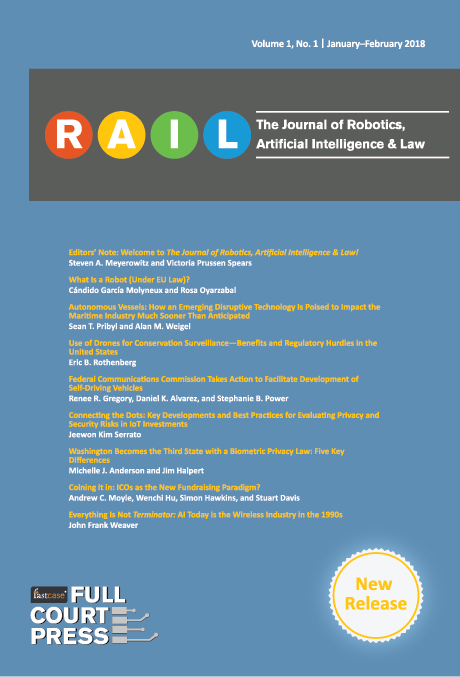
    First Published inThe Journal of Robotics, Artificial Intelligence & Law

    The Journal of Robotics, Artificial Intelligence & Law (RAIL) is the flagship publication of Full Court Press, an imprint of Fastcase. Since 1999, Fastcase has democratized the law and made legal research smarter. Now, Fastcase is proud to publish books and journals that are pioneering, topical, and visionary, written by the law’s leading subject matter experts. Look for more Full Court Press titles available in print, as eBooks, and in the Fastcase legal research service, or at www.fastcase.com/fullcourtpress.

    Blueprint for an “Artificial Intelligence Bill of Rights”

    Photo by Possessed Photography on Unsplash

    Abstract: In this article, the authors discuss the blueprint for an “AI Bill of Rights” unveiled recently by the Biden administration. The blueprint provides a clear indication of the Biden administration’s artificial intelligence regulatory policy goals. This article was first published in The Journal of Robotics, Artificial Intelligence & Law by Fastcase Full Court Press.

    More and more, artificial intelligence (AI) and other automated systems make decisions affecting our lives and economy. These systems are not broadly regulated in the United States—although that will change this year in several states. President Biden recently unveiled a blueprint for an “AI Bill of Rights,” motivated by concerns about potential harms from automated decision-making. Arising from an initiative the White House Office of Science and Technology Policy (OSTP) launched in 2021, the AI Bill of Rights lays out five principles to foster policies and practices—and automated systems—that protect civil rights and promote democratic values.

    For now, at least, adherence to these principles (and the steps recommended for observing them) remains voluntary—the blueprint is a guidance document with no enforcement authority attached to it. Notably, at inception, OSTP was unsure how the AI Bill of Rights might be enforced:

    Possibilities include the federal government refusing to buy software or technology products that fail to respect these rights, requiring federal contractors to use technologies that adhere to this “bill of rights” or adopting new laws and regulations to fill gaps. States might choose to adopt similar practices.

    The Biden administration decided to publish a nonbinding white paper, potentially recognizing the difficulty of shepherding legislation through any potential 118th Congress. Indeed, the document’s first page proclaims that it “is non-binding and does not constitute U.S. government policy.” Nor does it “constitute binding guidance for the public or federal agencies and therefore does not require compliance with the principles described herein.” Notwithstanding this disclaimer, the blueprint provides a clear indication of the Biden administration’s AI regulatory policy goals.

    The Executive Branch and also independent agencies are likely to follow this lead in their respective domains.

    Issues of Definition

    In the debate over the European Union’s pending Artificial Intelligence Act, the definition of “artificial intelligence” has attracted much discussion. OSTP sidesteps this issue in the blueprint by addressing “automated systems,” which are defined as “any system, software or process that uses computation as whole or part of a system to determine outcomes, make or aid decisions, inform policy implementation, collect data or observations, or otherwise interact with individuals and/or communities.” OSTP adds, “Automated systems include, but are not limited to, systems derived from machine learning, statistics or other data processing or AI techniques, and exclude passive computing infrastructure,” which OSTP also defines.

    The blueprint’s coverage of “automated systems” instead of “artificial intelligence” offers business a mixed bag. On the one hand, the broader scope aligns with the regulation of automated decision-making under California, Colorado,10 Connecticut, and Virginia12 privacy laws and New York City’s law on automated employment decision tools, all taking effect this year, as well as Article 2214 of the EU/UK General Data Protection Regulation.

    On the other hand, it potentially threatens international harmonization of regulations based on the seemingly narrower scopes of the UNESCO Recommendation on the Ethics of Artificial Intelligence and the OECD AI Principles (also shared by the G20). Much of the blueprint concerns protection of “rights, opportunities or access.” OSTP explains this phrase as “the set of: civil rights, civil liberties and privacy, including”:

    • “freedom of speech, voting, and protections from discrimination, excessive punishment, unlawful surveillance, and violations of privacy and other freedoms in both public and private sector contexts”;

    • “equal opportunities, including equitable access to education, housing, credit, employment, and other programs”; or

    • “access to critical resources or services, such as healthcare, financial services, safety, social services, non-deceptive information about goods and services, and government benefits.”

    This explanation’s expansiveness underscores the Biden administration’s stated intent that the blueprint apply to automated systems affecting any facet of society or the economy.

    Guiding Principles

    The blueprint outlines five principles for all automated systems with the potential to “meaningfully impact individuals’ or communities’ exercise of rights, opportunities or access”:
    • Safe and Effective Systems. Automated systems should be safe and effective. They should be evaluated independently and monitored regularly to identify and mitigate risks to safety and effectiveness. Results of evaluations, including how potential harms are being mitigated, should be “made public whenever possible.”
    • Algorithmic Discrimination Protections. Automated systems should not “contribute to unjustified different treatment” or impacts that disfavor members of protected classes. Designers, developers, and deployers should include proactive equity assessments in their design processes, use representative data sets, watch for proxies for protected characteristics, ensure accessibility for people with disabilities, and test for and mitigate disparities throughout the system’s life cycle.
    • Data Privacy. Individuals should be protected from abusive data practices and have control over their data. Privacy engineering should be used to ensure automated systems include privacy by default. Automated systems’ design, development, and use should respect individuals’ expectations about their data and the principle of data minimization, collecting only data strictly necessary for the specific context. OSTP stresses that consent should be used only where it can be appropriately and meaningfully provided, limited to specific use contexts and unconstrained by dark patterns; moreover, notice and requests for consent should be brief and understandable in plain language. Certain sensitive data (including data related to work, home, education, health, and finance) should be subject to additional privacy protection, including ethical review and use prohibitions.
    • Notice and Explanation. Operators of automated systems should inform people affected by their outputs when, how, and why the system affected them. This principle applies even “when the automated system is not the sole input determining the outcome.” Notices and explanations should be clear and timely and use plain language.
    • Human Alternatives, Consideration, and Fallback. People should be able to opt out of decision-making by automated systems in favor of a human alternative, where appropriate. Automated decisions should be appealable to humans.

    The blueprint also includes a “Technical Companion” that details “concrete steps” for building these five principles into “policy, practice or the technological design process.” Organizations developing, procuring, and deploying AI and other automated systems will find these concrete steps to be generally consistent with other guidance on best practices.

    What Next from the U.S. Government?

    Having drawn up the blueprint, the Biden administration is ready to build out its AI policies through guidance, rulemaking, and enforcement. This work is already under way.
    Thus far, guidance—both for ethical best practices and compliance with existing laws—has been most common. For instance:
    • Department of Energy AI Advancement Council. In May 2022, the Department of Energy established the AI Advancement Council20 to oversee coordination, advise on AI strategy, and address issues on the ethical use and development of AI systems.
    • Algorithmic Discrimination in Hiring. In May 2022, the Equal Employment Opportunity Commission (EEOC) and the Department of Justice released a technical assistance document that explains how employers’ use of algorithmic decision-making may violate the Americans with Disabilities Act. EEOC’s guidance is a part of its larger initiative to ensure that AI and “other emerging tools used in hiring and other employment decisions comply with federal civilbrights laws that the agency enforces.”
    • Consumer Protection. In May 2021, the Federal Trade Commission’s (FTC) published a blog post providing tips for responsible use of AI in compliance with Section 5 of the Federal Trade Commission Act, the Fair Credit Reporting Act, and the Equal Credit Opportunity Act.

    Increasingly, however, the Executive Branch and independent agencies have been shifting to rulemaking and enforcement:
    • Broad AI Regulation. In August 2022, FTC opened its “commercial surveillance” proceeding, which could lead to a wide range of rules on AI and other automated systems (as well as privacy and data security). FTC’s Advance Notice of Proposed Rulemaking asks a number of questions about algorithmic accuracy, validity, reliability, and error; algorithmic discrimination against traditionally protected classes and “other underserved groups”; and whether AI and other automated systems yield unfair methods of competition or unfair or deceptive acts or practices that violate Section 5 of the FTC Act.25
    • Workplace Protections. The Department of Labor is ramping up enforcement of required surveillance reporting to protect worker organizing. The Department of Labor also released a blog post titled “What the Blueprint for an AI Bill of Rights Means for Workers.”
    • Algorithmic Healthcare Discrimination. The Department of Health and Human Services (HHS) issued a proposed rule in August 2022 that, in relevant part, would prohibit algorithmic discrimination in clinical decision-making by covered health program and activities. HHS also planned to release an evidence-based examination of healthcare algorithms and racial and ethnic disparities by late e 2022.
    • Algorithmic Housing Discrimination. In June 2022, Meta (formerly, Facebook) settled a Justice Department Fair Housing Act suit (following a Department of Housing and Urban Development investigation). The government alleged that Meta had used algorithms in determining which Facebook users received housing ads and that those algorithms relied, in part, on characteristics protected under the Fair Housing Act. As part of the settlement, Meta agreed to change its targeted advertising practices and to pay the maximum civil penalty of $115,054.
    • Algorithmic Credit Discrimination. In March 2022, the Interagency Task Force on Property Appraisal and Valuation Equity released an Action Plan to Advance Property Appraisal and Valuation Equity that includes a commitment from regulators to include a nondiscrimination standard in proposed rules for automated valuation models. Also that month, the Consumer Financial Protection Bureau revised its Supervision and Examination Manual to focus on algorithmic discrimination as a prohibited unfair, deceptive or abusive acts or practice. Businesses should expect the blueprint to inform all such agency actions going forward. It is likely that these agencies will expand their AI initiatives while other agencies will become active addressing AI and other automated systems within their ambits.

    The Chamber of Commerce’s Concerns Following the blueprint’s release, the U.S. Chamber of Commerce (the Chamber) wrote34 OSTP Director Dr. Arati Prabhakar,
    highlighting a number of concerns:
    • Lack of Stakeholder Engagement. OSTP received insufficient stakeholder input in formulating the blueprint, having sought comments only on biometric-identification systems.
    • Poor Definitions. The blueprint supplies definitions of key terms, including “Automated System,” which lack precision and could undercut international harmonization of AI policies and standards.
    • Independent Evaluations. The current lack of “concrete” auditing standards and metrics for AI systems makes it  “pointless” to allow journalists, third-party auditors, and other independent evaluators “unfiltered access” to AI systems—as called for in the blueprint.
    • Conflation of Data Privacy and Artificial Intelligence. Data privacy and AI raise “distinctly different” “nuances and complexities,” so the two issues should not be conflated.

    The Chamber’s “unexpectedly forceful pushback” (to quote Politico’s Brendan Bordelon) to a supposedly nonbinding guidance document reflects the blueprint’s potential influence. In an interview, a representative said the Chamber expects dozens of federal agencies to incorporate the guidance into regulatory mandates and
    fears “copycats at the state and local level.” A patchwork of differing requirements could impose a substantial burden on businesses.

    Having released the Blueprint for an AI Bill of Rights with great fanfare, the Biden administration is unlikely to withdraw it in response to the Chamber’s critique. However, the critique probably does foreshadow coming battles in rulemaking dockets and legislative chambers around the country.

    Conclusion

    AI regulation is arriving swiftly. Businesses should monitor these changes and prepare their compliance programs. Companies with particular concerns may wish to raise them early in legislative and rulemaking processes while proposals remain fluid.


  • The Rise of Multi-Claimant Litigation in England and How Companies Can Manage Potential Exposure

    The Rise of Multi-Claimant Litigation in England and How Companies Can Manage Potential Exposure

    The Authors

    Sheila L. Birnbaum

    Mark S. Cheffo

    Dorothy Cory-Wright

    Evan Flowers

    Jacqueline Harrington

    Will Sachse

    Stephen Surgeoner

    Rachel Leary

    Caroline Power

    Julie Witham

    The Journal on Emerging Issues in Litigation

    Emerging Litigation Podcast

    Emerging Litigation PodcastProduced by HB Litigation and Law Street Media

    Interviews with leading attorneys and other subject matter experts on new twists in the law and how the law is responding to new twists in the world.

    The Rise of Multi-Claimant Litigation in England and How Companies Can Manage
    Potential Exposure

    “With the growth in US/English partnerships for bringing multi-claimant actions in England, there may be an increased interest in leveraging US discovery for copycat English claims. The larger mass torts become in the United States, the more likely they are to feed into related multi-claimant actions in England.”

    Abstract: Recent court decisions have signaled the English courts’ willingness to embrace multi-claimant litigation and to broaden the types of questions decided on a collective basis. These developments have led UK-based plaintiffs’ lawyers to expand mass tort filings, including doing so in partnership with US plaintiffs’ lawyers who are actively advertising in England. This article provides an overview of multi-claimant litigation in England, highlights some of the factors that may lead to its increase, and discusses steps that companies operating in the English market can take now to manage potential exposure.

    Three primary mechanisms for bringing collective actions before an English court:

    1) Representative actions, group litigation orders (GLOs), and collective actions before the Competition Appeal Tribunal (CAT).

    2) Representative actions, in their current form, and GLOs are products of the general Civil Procedure Rules (CPR).

    3) Representative actions originated in the common law and permit a representative claimant or defendant with the “same interest” in a claim to represent that interest on behalf of a class.

    Download the article now!

  • How Companies Seeking to Leave China for Mexico Can Mitigate Their Legal Risks and Protect Against New Ones

    How Companies Seeking to Leave China for Mexico Can Mitigate Their Legal Risks and Protect Against New Ones

    The Author

    Dan Harris

    Dan HarrisHarris Bricken

    Dan Harris (dan@harrisbricken.com) is co-founder of Harris Bricken where he focuses his practice on international law and protecting businesses in their foreign operations. A leading authority on the subject, he is also editor of the highly regarded China Law Blog, and a valued member of the Editorial Board of Advisors for the Journal of
    Emerging Issues in Litigation.

    The Journal on Emerging Issues in Litigation

    Emerging Litigation Podcast

    Emerging Litigation PodcastProduced by HB Litigation and Law Street Media

    Interviews with leading attorneys and other subject matter experts on new twists in the law and how the law is responding to new twists in the world.

    How Companies Seeking to Leave China for Mexico Can Mitigate Their Legal Risks and Protect Against New Ones

    “Chinese manufacturers commonly seek retaliation against foreign buyers that cease buying product from them. For this reason, it is critical that you line up your new suppliers (preferably in a country other than China) and have them ready to go before you even hint to anyone in China that you might cease or reduce production with an existing China supplier.”

    Abstract: The author, one of the leading authorities on the legal issues related to international manufacturing, discusses the risks companies will face if they move their manufacturing out of China, what they should do to mitigate those risks, and what new risks they will face in a new country, such as Mexico. He comments on a variety of concepts, including manufacturing agreements, protection of intellectual property, strategies for a safe departure, potential retaliation tactics, and even personal security matters.

    Download the article now!

  • Climate Change, Property Rights, and Conservation: Highlights from a Decade of Environmental Law (2013–2023)

    Climate Change, Property Rights, and Conservation: Highlights from a Decade of Environmental Law (2013–2023)

    The Author

    Victoria Kline

    Victoria Kline2023 J.D. and Incoming Associate at Reed Smith

    Victoria Kline (linkedin.com/in/victoria-kline) just graduated from the University of Miami School of Law, and is an incoming associate at Jones Day. She focused her studies on environmental law, which also will be her area of practice. (Congratulations to Victoria on her graduation and getting her start at Reed Smith!)

    The Journal on Emerging Issues in Litigation

    Emerging Litigation Podcast

    Emerging Litigation PodcastProduced by HB Litigation and Law Street Media

    Interviews with leading attorneys and other subject matter experts on new twists in the law and how the law is responding to new twists in the world.

    Climate Change, Property Rights, and Conservation:
    Highlights from a Decade of Environmental Law (2013–2023)

    Abstract: The author discusses nine recent decisions—all but one handed down by the Supreme Court—that demonstrate the ongoing debate over responsibility for the effects of climate change, how the courts are essentially asked to strike a balance between environmental protection and economic development, the intersection of property rights and conservation, and how litigants fared with their arguments over different aspects of this important and, many would say, existential dilemma. The author concludes with an update from the United Nations Framework Convention on Climate Change and the establishment of a loss and damage fund for countries harmed by climate change.

    “The past decade has seen numerous legal challenges and landmark rulings in environmental law, reflecting the growing recognition of the critical importance of protecting the environment for current and future generations. From the Supreme Court’s decision in Michigan v. EPA to the recent Juliana v. United States case, the judicial branch has dramatically changed the way litigation can be used to protect the interests of the earth and its inhabitants.”

    Download the article now!

  • Procedural Challenges to the IRS’s Compliance With the APA and Its Impact on Tax Litigation

    Procedural Challenges to the IRS’s Compliance With the APA and Its Impact on Tax Litigation

    The Author

    Jeffrey S. Luechtefeld

    Jeffrey S. LuechtefeldChamberlain | Hrdlicka

    Jeffrey S. Luechtefeld (jeff.luechtefeld@chamberlainlaw.com) is a tax controversy and litigation attorney with Chamberlain, Hrdlicka, White, Williams, and Aughtry (Atlanta, Georgia) where he focuses his practice on resolving tax disputes with the Internal Revenue Service, administratively or through litigation. Jeff previously was a Special Trial Attorney for the IRS Office of Chief Counsel as well as a director in the tax controversy practice of a big four accounting firm.

    The Journal on Emerging Issues in Litigation

    Emerging Litigation Podcast

    Emerging Litigation PodcastProduced by HB Litigation and Law Street Media

    Interviews with leading attorneys and other subject matter experts on new twists in the law and how the law is responding to new twists in the world.

    Procedural Challenges to IRS Compliance With the APA and Its Impact on Tax Litigation

    Abstract: The Administrative Procedure Act (APA) places specific requirements on agencies of the federal government when engaged in a “rule making” that has the force and effect  of law. Recently, the APA has become a focal point in tax litigation, due in large part to the IRS’s history of refusing to comply with the process mandated by the APA. This article focuses on procedural challenges to the IRS’s compliance with the APA based on the IRS’s history of non-compliance with the APA’s notice-and-comment requirement. It highlights recent trends in tax litigation and considers the future of APA challenges in this area.

    “IRS’s level of APA non-compliance matters significantly …

    “APA challenges predicated on the IRS’s failure to adequately follow the APA’s notice-and-comment process are inherently fact-intensive endeavors …

    “The challenging party should gauge the usefulness of the relief requested and balance that against the cost required to prevail …

    “Ultimately, APA challenges are important, and may be necessary for a taxpayer to get to argue the merits of their case, but they do not often end the dispute with the IRS.”

    Download the article now!

  • Ohio Supreme Court Ruling Sends Important Reminder: Long-Standing, Fundamental Principles of Insurance Policy Construction and Law Are Applicable to Cyber Claims

    Ohio Supreme Court Ruling Sends Important Reminder: Long-Standing, Fundamental Principles of Insurance Policy Construction and Law Are Applicable to Cyber Claims

    The Authors

    Judy Selby

    Judy SelbyKennedys

    Judy Selby (judy.selby@kennedyslaw.com) is a Partner at Kennedys (New York) where she focuses her practice primarily on insurance coverage matters with a concentration in coverage for exposures arising out of emerging technology, digital, and compliance risks.

    Tracey Kline

    Tracey KlineKennedys

    Tracey M.Kline (tracey.kline@kennedyslaw.com) is an Associate at Kennedys (Philadelphia) where she focuses her practice primarily on insurance coverage litigation and cyber matters.

    The Journal on Emerging Issues in Litigation

    Emerging Litigation Podcast

    Emerging Litigation PodcastProduced by HB Litigation and Law Street Media

    Interviews with leading attorneys and other subject matter experts on new twists in the law and how the law is responding to new twists in the world.

    Ohio Supreme Court Ruling Sends Important Reminder:

    Long-Standing, Fundamental Principles of Insurance Policy Construction and Law Are Applicable to Cyber Claims

    Abstract: On December 27, 2022, the Ohio Supreme Court unanimously ruled that a business owner’s property insurance policy issued by Owners Insurance Co. to EMOI Services, LLC did not afford coverage for losses sustained in a ransomware attack because computer software is “entirely intangible” and “cannot experience ‘direct physical loss or physical damage.’” EMOI Servs., LLC. v. Owners Ins. Co., 2022-Ohio-4649 (Ohio 2022). In doing so, the court reversed an attention-getting split decision by the lower appellate court. This article takes an in-depth look at the case and discusses its significant implications.

    The Ohio Supreme Court’s decision was based on its commonsense conclusions that software (as intangible property) cannot suffer physical damage, and that coverage for restoration of information under the Electronic Equipment Endorsement could not be triggered absent the threshold requirement of “direct physical loss or damage” to the media on which the information was stored. Although claims involving cyber events may be relatively new, this decision is an important reminder that long-standing, fundamental principles of insurance policy construction and law are applicable to cyber claims.

    Download the article now!

  • Unarmed or Unwell: How Federal Law Infringes Medical Marijuana Users’ Second Amendment Rights

    Unarmed or Unwell: How Federal Law Infringes Medical Marijuana Users’ Second Amendment Rights

    The Author

    Griffen Thorne

    Griffen ThorneHarris Bricken

    Griffen Thorne (griffen@harrisbricken.com) is an attorney in the Los Angeles office of Harris Bricken Sliwoski LLP, an international emerging markets law firm. He represents clients in highly regulated emerging industries, such as cannabis, in corporate and commercial transactions.

    The Journal on Emerging Issues in Litigation

    Emerging Litigation Podcast

    Emerging Litigation PodcastProduced by HB Litigation and Law Street Media

    Interviews with leading attorneys and other subject matter experts on new twists in the law and how the law is responding to new twists in the world.

    Unarmed or Unwell:
    How Federal Law Infringes Medical Marijuana Users’ Second Amendment Rights

    As Justice Amy Coney Barrett noted while on the Seventh Circuit, “legislatures have the power to prohibit dangerous people from possessing guns. But that power extends only to people who are dangerous.” In the coming years, the government’s ability to write off all medical marijuana users as dangerous is likely to be curtailed, even if the Controlled Substances Act continues to make marijuana use a federal crime.

    Abstract: In the wake of the 2022 U.S. Supreme Court case New York State Rifle & Pistol Association, Inc. v. Bruen, federal courts have reached opposite outcomes on whether federal prohibitions on marijuana users’ rights to own or possess firearms are constitutional. As a result, there is a high likelihood of a circuit split that results in the overturning of those federal laws. The author discusses Bruen and several other cases at the intersection of drug laws and gun laws.

    Download the article now!