Category: News

  • Gamification of Stock Trading with Brad Rustin

    Gamification of Stock Trading with Brad Rustin

    Gamification of Stock Trading with Brad Rustin

    “What’s the deal?” you ask? Find out! Listen to my interview with FinTech attorney Brad Rustin, a partner with Nelson Mullins. In addition to chairing the firm’s Financial Services Regulatory Practice, Brad counsels  financial institutions in regulatory matters, including strategic agreements, product development, and operational compliance.

    A large portion of his work is on bank and non-bank partnerships involving white-label deployments, FinTech partnerships, or payments, digital assets, cryptocurrency, and lending partnerships. Brad is a Certified Anti-Money Laundering Specialist (CAMS) by ACAMS and a Certified Regulatory Compliance Manager (CRCM) by the American Bankers Association.

    He received his JD, magna cum laude, from the University of South Carolina School of Law and his BA in Political Science and History, cum laude, from Furman University. And now, he is not only a guest on the Emerging Litigation Podcast, but the FinTech advisor on the  Editorial Advisory Board of the Journal on Emerging Issues in Litigation.

    This podcast is the audio companion to the Journal on Emerging Issues in Litigation, a collaborative project between HB Litigation Conferences and the legal news folks at Law Street Media, and the Fastcase legal research family, which includes Docket Alarm and Judicata. If you have comments or wish to participate in one our projects, or want to tell me how insightful and informative our guests are, please drop me a note at Editor@LitigationConferences.com.

    Thanks to Brad for speaking with me about this fascinating subject. As for me, I will stay away from “game trading.” Hearing people describe it reminds me of my PacMan obsession in college, which frequently cost me many hours that I should have spent differently, and too often a functioning shoulder.

    Tom Hagy

    via GIPHY

    As brokerages focus on enhancing user experience, they risk shifting their customer’s focus from serious financial decisions to a game-like experience.  Some think this is a good thing. That it will help engage the next generation of traders. Others think it’s a bad thing. That it will create a more spastic type of trader with unrealistic expectations on potential returns. State and federal regulators are focusing on digital brokerages and exploring guardrails for these types of platforms.

    The challenges facing traditional technology providers (volume controls, fraud, system outages, and liquidity) are now facing these digital brokerages—with real-life consequences for individuals and their savings and retirement accounts.

    One company that has been making headlines is Robinhood, which was on the receiving end of a $70 million fine handed down by the Financial Industry Regulatory Authority, or FINRA, for what it called “systemic supervisory failures.”

    In coming up with the award, FINRA said it considered the “widespread and significant harm suffered by customers, including millions of customers who received false or misleading information from the firm, millions of customers affected by the firm’s systems outages in March 2020, and thousands of customers the firm approved to trade options even when it was not appropriate for the customers to do so.” Robinhood is also defending itself in litigation involving dozens of cases.

    Will we continue to see litigation over these platforms as more and more retail customers (many young and inexperienced) realize that securities involve market risks?

    What’s the deal?
  • A Special Episode: A lovable litigator with Danny Karon

    A Special Episode: A lovable litigator with Danny Karon

    A Special Episode: A lovable litigator with Danny Karon

    For  30 years attorney Daniel R. Karon has successfully represented plaintiffs and defendants in class-action and individual lawsuits. He’s also chair of one of the leading class action conferences for lawyers, judges and law professors: the American Bar Association National Institute on Class Actions. He’s passionate about educating up-and-coming lawyers. He teaches and writes extensively, and has been featured on podcasts and television news shows.  

    While practicing law (handling some intensely serious matters), Danny became acutely aware of “a societal bias against access to justice where people who need justice the most often get it the least.” One response to that was to launch Your Lovable Lawyer, a multi-media website whose goal is to “make  justice more accessible to people who don’t know, can’t find, or can’t pay for lawyers.” He endeavors to provide actionable insights regarding common legal problems. He refers to his “lovable” concept as “legal wellness,” and encourages regular folks to take a proactive approach to legal matters and potential conflicts. 

    This podcast is the audio companion to the Journal on Emerging Issues in Litigation, a collaborative project between HB Litigation Conferences and the Fastcase legal research family, which includes Full Court Press, Law Street Media, Docket Alarm and, most recently, Judicata. If you have comments or wish to participate in one our projects, or want to tell me how lovable Danny is, please drop me a note at Editor@LitigationConferences.com. 

    via GIPHY

  • Impact of Surfside Condo Collapse with Judah Lifschitz

    Impact of Surfside Condo Collapse with Judah Lifschitz

    Impact of Surfside Condo Collapse with Judah Lifschitz

    Joining me is experienced construction law attorney Judah Lifschitz of Shapiro, Lifschitz & Schram  who spoke about the near- and long-term impacts of the Surfside condo collapse not only in Florida around the country.  Judah has extensive experience dealing with construction matters, representing clients in engineering, procurement and construction contracts and disputes. He represents and advises government agencies and private owners; regional, national and international contractors; construction managers and subcontractors; design professionals; and insurance companies. Notably, Judah won one of the largest liquidated damages awards in the history of the construction industry.  Education: George Washington University, J.D.; Yeshiva University, B.A., magna cum laude.

    This podcast is the audio companion to the Journal on Emerging Issues in Litigation, a collaborative project between HB Litigation Conferences and the Fastcase legal research family, which includes Full Court Press, Law Street Media, Docket Alarm and, most recently, Judicata. If you have comments or wish to participate in one our projects, or want to tell me how insightful and informative Judah is, please drop me a note at Editor@LitigationConferences.com.

    Thanks to Judah for speaking with me about this important topic. I was especially proud that I pronounced his name correctly on the first try, though he assured me that I could in no way do more damage to it than those who have come before me. (Clearly he doesn’t know me well.)

    Tom Hagy
    (pronounced HEY-ghee, for the record)

    via GIPHY

    Nothing illustrates the tragic consequences of building decay more than the June 24, 2021, collapse of the Champlain Towers South in Surfside, Florida, which claimed the lives of nearly 100 residents.

    The event raises questions about the building inspection process not only in Florida but around the country.

    What caused this calamity?

    Who is responsible?

    How many other buildings are in similar condition?

    Since any compensation for the loss of life, injuries, and property damage will likely be astronomical, where will any financial awards come from?

  • Drone Law with Kathryn Rattigan

    Drone Law with Kathryn Rattigan

    Drone Law with Kathryn Rattigan

    Joining me to discuss this emerging area of law is Kathryn M. Rattigan, a member of the Business Litigation Group, the Data Privacy + Cybersecurity Team, and the Drone Compliance Team in the Rhode Island office of Robinson Cole.  Kathryn advises clients on these matters with expertise in the relevant Federal Aviation Administration regulations. She and her colleagues also advise clients on employee and subcontractor contracts, insurance policies, privacy regulations, state and local laws, and best practices as recommended by the National Telecommunications and Information Administration.  She handles product defect, personal injury, and property damage litigation, too.  Kathryn is a frequent contributor to the excellent Robinson Cole Data Privacy + Cybersecurity Insider blog.  She holds a J.D. from the Roger Williams University School of Law and a B.A. (magna cum laude) from Stonehill College.

    This podcast is the audio companion to the Journal on Emerging Issues in Litigation, a collaborative project between HB Litigation Conferences and the Fastcase legal research family, which includes Full Court Press, Law Street Media, Docket Alarm and, most recently, Judicata. If you have comments or wish to participate in one our projects, or want to tell me how insightful and informative Kathryn is, please drop me a note at Editor@LitigationConferences.com. This podcast is based on an article she wrote for the Journal.

    Just to clarify. Kathryn does own a drone, but not a “sheep drone.” I regret the error, and I wouldn’t have it any other way.  Thanks to Kathryn for speaking with me about this fascinating area of the law.

    Tom Hagy
    Host and Litigation Enthusiast

    via GIPHY

    The sky will be speckled with commercial drones, carrying our precious products and pills, or performing risky work, like inspecting bridges and buildings, monitoring crops and livestock, and keeping an eye on pipelines and oil rigs.

    It’s not “if,” but “when.”

    What must companies know about deploying a drone fleet?

    What industries are leading the way?

    What are the potential legal liabilities?

    How does one begin to navigate the regulatory labyrinth?

    If one is flying over my swimming pool taking photos, may I shoot it down?

    And who in their right minds would ever allow a teenage boy to operate one?

    via GIPHY

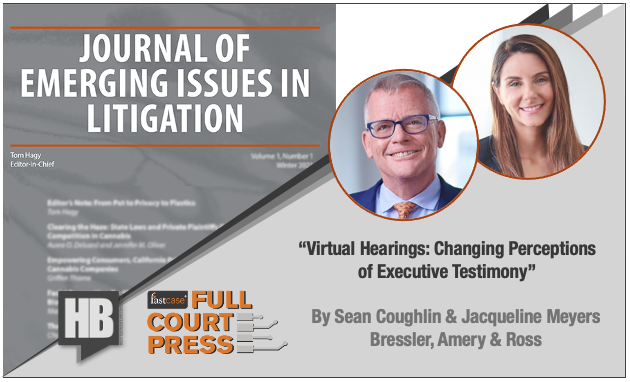
  • Virtual Hearings: Changing Perceptions of Executive Testimony?

    Virtual Hearings: Changing Perceptions of Executive Testimony?

    Virtual Hearings: Changing Perceptions of Executive Testimony?

    Abstract
    Given the newly acceptable ease of securing testimony via webcam—necessitated by the pandemic—this article focuses on efforts to compel the appearance of corporate executives to testify in litigation. While there are many practical advantages to virtual testimony, the authors maintain that mere convenience cannot replace legal standards of relevance and undue burden when pursing the testimony of executives.

    Authors

    Sean J. Coughlin (scoughlin@bressler.com) is a Principal in the Financial Institutions group at Bressler, Amery & Ross, P.C., where he represents institutions and individuals in regulatory investigations and defense litigation. Before joining the firm, he was an Executive Director in the legal department at Morgan Stanley, a Managing Director at Citigroup/Smith Barney, and a Senior Assistant District Attorney in the Kings County District Attorney’s office.

    Jacqueline R. Meyers (jmeyers@bressler.com) is an associate at Bressler, Amery & Ross, P.C., whose practice focuses on securities defense litigation, arbitration, and regulatory investigations. She has specialized experience in litigation concerning arbitrability and enforcement of arbitration awards.

    About
    The Journal on Emerging Issues in Litigation is a co-production of HB, Fastcase, and Law Street Media. You can also hear the complementary (and complimentary) Emerging Litigation Podcast wherever podcasts appear. For questions, contact Tom Hagy, Editor in Chief, at Editor@LitigationConferences.com.

    Loading Viewer…

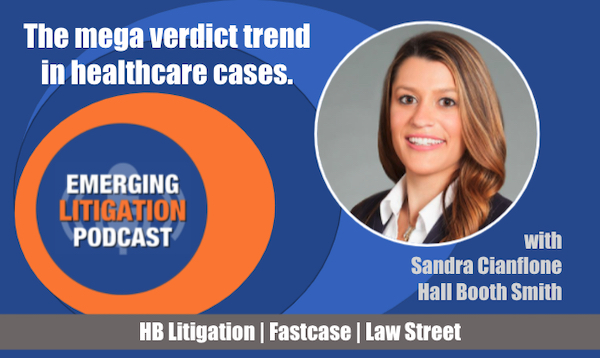
  • The Mega Verdict Trend in Healthcare Litigation with Sandra Cianflone

    The Mega Verdict Trend in Healthcare Litigation with Sandra Cianflone

    The Mega Verdict Trend in Healthcare Litigation with Sandra Cianflone

    Joining me to discuss this high-stakes litigation is Sandra M. Cianflone of Hall Booth Smith, P.C.Sandiecounsels and defends hospitals, physicians, nurses and institutional employees in a broad spectrum of catastrophic injury and medical malpractice cases. She received her Juris Doctorate from Pace University School of Law and her undergraduate degree from Fairleigh Dickinson University.

    This podcast is the audio companion to the Journal on Emerging Issues in Litigation, a collaborative project between HB Litigation Conferences and the Fastcase legal research family, which includes Full Court Press, Law Street Media, Docket Alarm and, most recently, Judicata. If you have comments or wish to participate in one our projects, or want to tell me how insightful and informative Sandie is, please drop me a note at Editor@LitigationConferences.com. This podcast is based on an article she wrote for the forthcoming issues of the Journal.

    Note that in my introduction I have created the phrase “badly wrong,” which is, itself, badly wrong.  Listen to the bitter end when Sandie and I discuss working from home, and how we really feel about family and co-workers.  Feel free to scold me at the email address provided. I hope you enjoy the interview and this professional’s practical insights into defending healthcare providers.

    Tom Hagy

    Damage awards against physicians, hospitals, and other healthcare providers have been coming in bigger and bigger, with juries awarding more than $20 million in a string of cases that should send chills down the spines of defendants and counsel. 

    What are the factors behind this trend? Besides the severe (or even alarming)  nature of the harm alleged, what is fueling these mega verdicts?

    What can defense attorneys do, knowing they are facing a well-organized, well-funded plaintiffs bar?

    For that matter, what can defense attorneys learn from their opponents?

    What strategies can defense employ early in the life of a case?

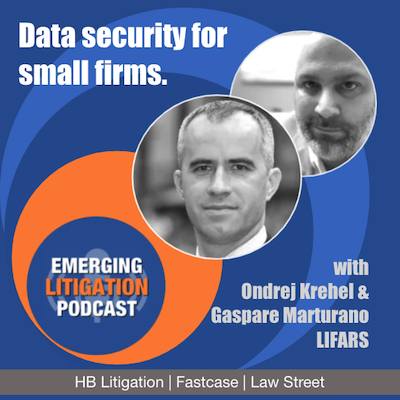
  • Data Security for Small Law Firms with Ondrej Krehel and Gaspare Marturano

    Data Security for Small Law Firms with Ondrej Krehel and Gaspare Marturano

    Data Security for Small Law Firms with Ondrej Krehel and Gaspare Marturano

    Joining me to discuss this important issue is Ondrej Krehel, CEO & Founder of LIFARS, a New York-based incident response and digital forensics firm specializing in cybersecurity protection.
    Ondrej is recognized for his digital forensic expertise and ethical hacking skills. He participates in high-profile engagements around the world using his proprietary methodology to achieve the most rapid root-cause analysis and remediation. He is a former lecturer at FBI Training Academy who has led forensic investigations and cybersecurity involving the U.S. government, including military cyber special operations. He holds a Ph.D. in Computer Forensics from Police Academy in Bratislava, Slovakia, an M.S. degree in Mathematical Physics from Comenius University in Bratislava, and an Engineering Diploma from Technical University in Zvolen, Slovakia.
    Joining Ondrej and me is Gaspare J. Marturano, Chief Marketing Officer at LIFARS. Gaspare is a former Director of Information Systems for a large Connecticut law firm and has consulted on these issues with a number of other law firms.
    This podcast is the audio companion to the Journal on Emerging Issues in Litigation, a collaborative project between HB Litigation Conferences and the Fastcase legal research family, which includes Full Court Press, Law Street Media, and Docket Alarm. If you have comments or wish to participate in one our projects, or want to tell me how insightful and informative Ondrej and Gaspare are, please drop me a note at Editor@LitigationConferences.com.
    I particularly enjoyed hearing about what one kid was doing at 17, an age when I was certain I would be sought out for my rock drumming artistry. Of course, that kid was operating a criminal enterprise. I was just trying to impress girls.
    Tom Hagy

    Law firms are sweet targets for hackers given the rich data they store, from intellectual property to confidential merger details to personal and health information.

    The last decade is rife with headlines about data hacks and ransomware attacks at even the most sophisticated global law firms.

    Yet, according to the 2020 Legal Technology Survey Report conducted by the American Bar Association’s Legal Technology Resource Center fewer than half of the firms polled employ some of the most basic security measures, such as email and file encryption.

    What can smaller firms do to protect their data and that of their clients?

  • Plastics-Related Liabilities and Insurance Recovery with Mikaela Whitman

    Plastics-Related Liabilities and Insurance Recovery with Mikaela Whitman

    Plastics-Related Liabilities and Insurance Recovery with Mikaela Whitman

    Joining me to discuss this important civil statute is Mikaela Whitman for what was an informative and insightful podcast on this potentially enormous area of litigation. It’s based on her article — One Word: Plastics. Two Words: Pollution Exclusion. Why CGL Policies Should Cover Plastics-Related Liabilities — which will be featured in the inaugural issue of the Journal on Emerging Issues in Litigation  in January 2021.
    Mikaela (mwhitman@pasichllp.com) is a partner in Pasich LLP’s New York office and a member of the firm’s insurance recovery practice. Her practice focuses on the representation of insureds in all phases of insurance coverage recovery, from pre-suit negotiations through alternative dispute resolution and litigation.
    The Journal and Podcast are part of a collaborative project between HB and the Fastcase legal research family, which includes Full Court Press, Law Street Media, Docket Alarm and, most recently, Judicata. If you have comments or wish to participate in one our projects, or want to tell me how awesome Mikaela is, drop me a note at Editor@LitigationConferences.com.
    We hope you enjoy the interview.

    As we see liability actions relating to plastics creeping into the nation’s dockets, what types of claims will survive?

    How much more of this might we see?

    And if it really hits the fan, how will insurance companies respond?

    Will policyholders find protection in their comprehensive general liability policies?

    Their directors and officers policies? Other policies?  

  • The False Claims Act with Jack Siegal

    The False Claims Act with Jack Siegal

    The False Claims Act with Jack Siegal

    Joining me to discuss this important civil statute is Jack Siegal of McGlinchey Stafford in Boston. Jack’s practice focuses on financial services litigation, complex commercial disputes, government investigations and white-collar defense, securities litigation, regulatory proceedings, and compliance.

    This podcast is the audio companion to the Journal on Emerging Issues in Litigation, a collaborative project between HB Litigation Conferences and the Fastcase legal research family, which includes Full Court Press, Law Street Media, Docket Alarm and, most recently, Judicata. If you have comments or wish to participate in one our projects, or want to tell me how insightful and informative Jack is , please drop me a note at Editor@LitigationConferences.com.

    I hope you enjoy the interview, and especially how I managed not to include Jack’s answer to whether my dog could be sued for violating the FCA. “Nope. Not a person,” he said, with zero hesitation. I want to thank Jack for immediately taking on the role as Shiloh’s advocate, and for speaking with me about this important law.  –Tom Hagy

    Unscrupulous contractors have been ripping off the federal government for as long as there has been a federal government. President Lincoln, tired of being sold lame mules and rancid rations, signed the Federal Claims Act into law during The Civil War.

    In the last two decades the government, with the help of whistleblowers, has raked in more than $20 billion. 

  • Cryptocurrency with Stephen Palley

    Cryptocurrency with Stephen Palley

    Cryptocurrency with Stephen Palley

    Joining me to discuss this paradigm-shattering model is Anderson Kill Partner Stephen D. Palley, a seasoned trial lawyer and litigator with extensive experience in complex commercial disputes like insurance recovery, securities litigation, and corporate governance.  Stephen has significant hands-on software development and design experience. Based in the firm’s D.C. office, he is co-chair of its cross-disciplinary blockchain and virtual currency group. At several points during our conversation I referred to an article co-written by Stephen and his New York colleague Joshua Gold, titled Protecting Cryptocurrency Assets. Stephen earned his J.D. from Washington University, his M.A. from the University of Delaware, and his B.A. (cum laude) from Tufts University (Go Jumbos!).
    This podcast is the audio companion to the Journal on Emerging Issues in Litigation, a collaborative project between HB Litigation Conferences and the Fastcase legal research family, which includes Full Court Press, Law Street Media, Docket Alarm and, most recently, Judicata. If you have comments or wish to participate in one our projects, or want to tell me how insightful and informative Stephen is, please drop me a note at Editor@LitigationConferences.com.
    I hope you enjoy the interview, especially when Leo, my cat, knocked over my microphone and when Stephen educated me on the existence of the Weird Beard Festival and other whisker-based celebrations. –Tom Hagy

    Cryptocurrency assets now exceed $1.5 trillion globally.

    What a great innovation, as is the magic that makes these transactions possible. Of course, I’m talking about blockchain. The possibilities are endless on both counts. No central authority. No regulators.

    But (there’s always a but), thanks to the world’s miscreants, desperados and other baddies there is escalating potential for theft of these assets whether they are held in Bitcoin or other forms of digital currency.

    What should businesses consider if they plan to invest in virtual assets?

    How might they mitigate risk? What security measures should they have in place?

    Is the theft of digital currency covered by insurance?