Category: News

  • Announcing the Complex Litigation Ethics Conference

    Announcing the Complex Litigation Ethics Conference

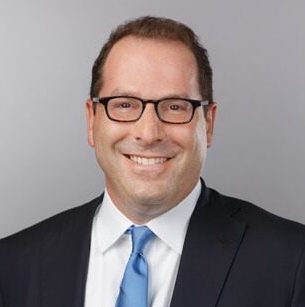
    Joshua P. Davis

    Joshua P. DavisProfessor & Practicing Attorney

    A leading academic and practitioner, Joshua P. Davis (davisj@usfca.edu) is a nationally recognized expert on legal ethics and class actions, as well as on artificial intelligence in the law, antitrust, civil procedure, free speech, and jurisprudence. He has published more than 30 scholarly articles and book chapters on these subjects and is currently writing a book on AI titled Unnatural Law, which will be published by Cambridge University Press. He is Research Professor of Law at the University of California Hastings College of Law, and a Shareholder of the Berger Montague PC law firm and Manager of its new San Francisco Bay Area Office. Before taking these posts, for more than 20 years Davis was a tenured Professor of Law at University of San Francisco Law School, where he also served as the Director of the Center for Law and Ethics.

    Davis is also a member of the Editorial Board of Advisors for the Journal on Emerging Issues in Litigation, published by Fastcase Full Court Press. Tom Hagy, Editor in Chief.
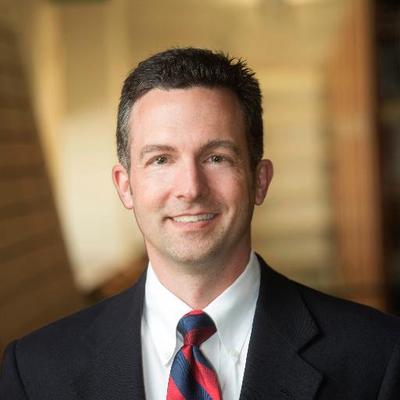
    Scott Dodson

    Scott DodsonCenter for Litigation and Courts

    An expert in civil procedure and federal courts, Professor Scott Dodson is the James Edgar Hervey Chair in Litigation and Geoffrey C. Hazard Jr. Distinguished Professor of Law at UC Hastings Law. He has published seven book titles, including The Legacy of Ruth Bader Ginsburg (Cambridge 2015) and New Pleading in the Twenty-First Century (Oxford 2013). He has written around 100 shorter works appearing in such journals as Stanford Law Review, New York University Law Review, Michigan Law Review, University of Pennsylvania Law Review, California Law Review, Virginia Law Review, Duke Law Journal, Northwestern University Law Review, Georgetown Law Journal, American Journal of Comparative Law, American Journal of International Law, and Law & Society Review. His scholarly writings have been cited in more than 30 court opinions and have been downloaded more than 45,000 times. For 2010-14, he was listed as the 9th (tied) most-cited civil-procedure scholar. Professor Dodson is a frequent commentator in the news, including appearances on the 10:00 Nightly News, NPR Radio, and CNN Radio; quotes in various print media; and blogging stints at SCOTUSblog, SCOCAblog, Civil Procedure & Federal Courts Blog, and PrawfsBlawg.

    You can also listen to Josh on the Emerging Litigation Podcast!

    New Litigation Ethics Conference to Feature Sitting Judges, Legal Scholars, Prominent Attorneys

    For Immediate Release

    SAN FRANCISCO – Aug. 25, 2022 – Luminaries and thought leaders in the complex litigation arena will gather in San Francisco on Saturday, Oct. 22, 2022, to discuss insights and practices on an issue of critical significance to the nation’s justice system: ethical conduct among litigants and litigators.

    With a projected in-person and remote audience of 100 plus, this important continuing legal education program will be held at the UC Hastings College of Law in association with the school’s Center for Litigation in Courts. Professors Joshua P. Davis and Scott Dodson have assembled a faculty of leading jurists, litigators, and other subject matter experts.

    Complex Litigation Ethics Conference
    Oct. 22, 2022
    UC Hastings College of Law
    Learn more

    “Data suggest that, depending on the year, as much as half of all cases filed in federal court are part of multidistrict litigation, or MDL, proceedings or involve proposed class actions,” said Professor Davis, who is both a research professor at UC Davis and managing partner of the San Francisco offices of Berger Montague, a prominent class action and complex litigation law firm.

    According to the U.S. Judicial Panel on Multidistrict Litigation there were 186 MDL dockets pending, which brought together 770,623 actions, with 426,495 pending as of July 2022. At the same time, thousands of new class actions are filed each year (some put the number as high as 10,000) in state and federal courts representing millions of named and potential class members. Cases and claim types run the gamut, such as consumer product liability, antitrust, toxic substances, drug and device liability, data breaches, securities, employment, environmental contamination, and both injury and damage claims arising from wildfires and floods, to name a few.

    “Despite these figures, insufficient scholarly attention has been paid to the ways in which ethical rules, which are typically designed for traditional litigation, should be adapted and applied to MDLs and class actions,” said Professor Davis. “The Complex Litigation Ethics Conference will address these important and timely issues.”

    Topics include adapting general legal ethics rules to complex matters; ethics in litigation funding; diversity, equity, and inclusivity in complex litigation; and communications with “absent class members.”

    U.S. Judge Jon S. Tigar of the Northern District of California will be among the speakers. Judge Tigar has or continues to preside over headline-grabbing litigation brought against Apple Inc., Meta Platforms Inc. (Facebook), Twitter Inc., Uber Technologies Inc., Wells Fargo & Company, Subway restaurants, Sanofi S.A., and others.

    Also on the faculty are:

    • Lynn A. Baker, University of Texas School of Law
    • Jennifer Bennett, Gupta Wessler PLLC
    • Eric Cramer, Berger Montague PC
    • Lauren Godshall, Tulane Law School
    • Alexandra D. Lahav, Cornell Law School
    • Brent Landau, Hausfeld
    • Roger Michalski, University of Oklahoma College of Law
    • Melissa Mortazavi, University of Oklahoma College of Law
    • Sarah Ray, Latham & Watkins LLP
    • Maya Steinitz, University of Iowa, College of Law
    • Brad Wendel, Cornell Law School

    Three annual Awards for Excellence in Ethics in Complex Litigation will also be announced during the event, one to a plaintiffs’ attorney or law firm, one to a defense attorney or law firm, and one to a judge, scholar, third-party neutral, party to litigation, government official, other lawyer or law firm, non-profit organization, and other participant in or commentator on complex litigation. The winners will have demonstrated excellence in promoting ethics in class actions or other complex litigation (e.g., MDLs).

    Huntington National BankThe event is being co-sponsored by Huntington National Bank, a nationwide provider of settlement fund and other financial services for law firms.

    Members of the legal and business press are invited to request passes to attend the event in San Francisco or via webstream, and to receive program materials. Pre-program interviews with the conference leaders and faculty should be addressed to Tom Hagy, +1 (484) 844-0428, or Editor@LitigationConferences.com.
    DOWNLOAD THE RELEASE

  • Litigating a Claim to Recover Liquidated Damages by Laura Fraher

    Litigating a Claim to Recover Liquidated Damages by Laura Fraher

    The Author

    Laura C. Fraher

    Laura C. FraherShapiro, Lifschitz and Schram

    Laura C. Fraher (fraher@slslaw.com) is a senior attorney in the trial and construction group at Shapiro, Lifschitz & Schram in Washington, D.C. She has extensive experience in civil litigation at both the trial court and appellate level. Competitive by nature, Laura played rugby for nearly 20 years. She puts this competitive spirit to work through her passion for the law and her clients.

    Education: St. John’s University School of Law, J.D., 2001, magna cum laude; SUNY College at Geneseo, B.A., Political Science, 1998.

    The Journal on Emerging Issues in Litigation

    Emerging Litigation Podcast

    Emerging Litigation PodcastProduced by HB Litigation and Law Street Media

    Interviews with leading attorneys and other subject matter experts on new twists in the law and how the law is responding to new twists in the world.

    Litigating a Claim to Recover Liquidated Damages:

    Enforceability Depends on Evidence of Good Faith Expectations

    “The tests and standards that courts apply to evaluate whether a particular liquidated damage provision is enforceable vary from state to state and it is imperative that litigants research and fully appreciate the particular standards that will be applied by the court in which they are litigating.”

    Abstract: The liquidated damages provision in a contract is a useful mechanism for mitigating risk in the event one of the parties to an agreement breaches the contract, costing the aggrieved party sometimes significant difficulty and substantial expense. Unfortunately, these provisions are often challenged, allowing the party responsible for the beach to exacerbate the burdens on the other party. In this article, the author discusses concepts of enforceability, proof, and avoiding litigation over liquidated damage provisions.

    A liquidated damage provision is an advance agreement of the damages that a party will be entitled to recover in the event of a future breach by the other party to a contract. These provisions can be an important tool for risk allocation and mitigation between parties when entering into a contract; both because the provision allows the parties to predict with certainty the financial ramifications of a future breach and because the liquidated damage provision should protect the aggrieved party against the difficulty and expense associated with proving actual damages in the event of a breach.

    In reality, however, when a breach occurs, liquidated damage provisions are frequently challenged and become the subject of costly litigation.  At the outset, it should be noted that the enforceability of a liquidated damage provision is generally considered an issue of law to be determined by the court, not an issue of fact to be presented to a fact finder. Thus, the key threshold issue of enforceability is likely to be determined on a pretrial motion rather than at trial and you should be prepared with both evidence and argument in order to sustain your claim.

    If you are faced with a challenge to dismiss your claim to recover liquidated damages based on unenforceability, it is important to remember that the law is in your favor.

    Liquidated damage provisions are viewed favorably by courts across the country and will generally be enforced so long as a court is satisfied that a liquidated damage provision is a stipulated agreement based on anticipated actual damages and not a penalty. A liquidated damages provision will be considered a penalty, and therefore unenforceable, if the court determines that the provision is designed to induce or secure performance by one party; conversely, a liquidated damage provision will not be viewed as a penalty, and will therefore be enforced if the court is satisfied that the provision is designed not to punish, but to provide a sum certain as compensation for a breach.

    Download the article now!

  • Litigation’s Role in Gun Safety Advocacy with Adam Skaggs

    Litigation’s Role in Gun Safety Advocacy with Adam Skaggs

    We’re closing in on 400 million guns in America, weapons that have been used to kill 1.5 million Americans between 1968 and 2017. Can litigation be an effective tool in curbing this loss of life?

    In 2020 alone there were more than 45,000 gun deaths. The beyond tragic and senseless mass shootings at schools has become all too routine. Most Americans want stricter gun laws which they believe will reduce the senseless killing in our country, which leads the world in both the number of privately owned firearms and gun-related deaths.

    The Supreme Court, of course, didn’t take public opinion into account when it struck down a more than century old New York City ban on concealed firearms. Politicians do, however, pay close attention to polls. At the federal level, President Joe Biden signed a bipartisan law designed to make Americans safer in our gun-toting nation. Hailed as a “great start” and a rare but welcome exercise in reaching across the aisle, the law will result in safer citizens, but didn’t include much of what gun advocates say is really needed to effect meaningful change. In California, Governor Gavin Newsom signed a new law that gives citizens incentives to pursue gun manufacturers and dealers who sell illegal firearms. In New York, Democratic leaders, undaunted by the Supreme Court, have pushed through new gun restrictions at vulnerable locations like schools, malls, and stadiums.

    But what can lawyers and lawsuits do about it? Plenty. What reasonable measurers can be put into place that will not infringe on Second Amendment rights?  Several. Are we seeing litigation over these issues? You bet.

    For more specifics, listen to my interview with Adam Skaggs, chief counsel and policy director at leading gun safety advocacy group Giffords Law Center, co-founded by former Congresswoman Gabby Giffords. Prior to Giffords Law Center Adam was senior counsel at Everytown for Gun Safety and at the Brennan Center for Justice, where he worked on election law issues.  Adam’s commentary has been published in Slate, Politico, the Atlantic, and the New York Times, among other publications, and he has been widely quoted by media ranging from the Wall Street Journal and Fox News to the New York Times and MSNBC. Adam graduated summa cum laude from Brooklyn Law School, received an MS in Urban Affairs from Hunter College of the City University of New York, and holds a BA, awarded with distinction, from Swarthmore College.

    If you would like to learn more about Giffords Law Center and how you can get engaged, please reach out to to them. You may also email Adam directly. 

    This podcast is the audio companion to the Journal on Emerging Issues in Litigation. The Journal is a collaborative project between HB Litigation Conferences and the Fastcase legal research family, which includes Full Court Press, Law Street Media, and Docket Alarm. The podcast itself is a joint effort between HB and our friends at Law Street Media. If you have comments or wish to participate in one our projects please drop me a note at Editor@LitigationConferences.com.

    Gun Safety: The Role of Litigation in Advocacy

    Adam Skaggs

    Adam SkaggsChief Counsel & Policy Director

    Adam Skaggs serves as Giffords Law Center’s chief counsel and policy director. Previously, he was senior counsel at Everytown for Gun Safety and at the Brennan Center for Justice, where he worked on election law issues. Adam was also a litigation associate at Paul, Weiss, Rifkind, Wharton & Garrison and a law clerk at the Eleventh Circuit and the US District Court for the Eastern District of New York.

    Adam’s commentary has been published in Slate, Politico, the Atlantic, and the New York Times, among other publications, and he has been widely quoted by media ranging from the Wall Street Journal and Fox News to the New York Times and MSNBC.

    Adam graduated summa cum laude from Brooklyn Law School, received an MS in Urban Affairs from Hunter College of the City University of New York, and holds a BA, awarded with distinction, from Swarthmore College.

  • High-Asset Divorce Litigation with Robert D. Boyd and Kimberli C. Withrow

    High-Asset Divorce Litigation with Robert D. Boyd and Kimberli C. Withrow

    High-Asset Divorce Litigation 

    Let’s assume this is good news. The divorce rate appears to be coming down. Either people are more committed to these unions or have succumbed to lifetimes of misery. But the common belief — that “50% of all marriages end in divorce” — doesn’t enjoy statistical support. Six percent of people who divorce get back together, so that’s something, too.  

    According to Monster.com, the rate is higher among people working in fading industries, like certain machine operators. Despite frequent coverage of Hollywood breakups, they don’t mention entertainers, other than dancers and choreographers, who don’t fare well in marriage. Lawyers, in general, do not have a particularly high divorce rate.

    For insights into high-asset divorces, listen to my interview with Robert D. Boyd and Kimberli C. Withrow  of Boyd Collar Nolen Tuggle & Roddenbery.

    Bob Boyd is a widely recognized leader in the practice of high-net-worth divorce litigation and contested custody cases. He is a former prosecutor and a U.S. Army Ranger and Paratrooper.  Education: J.D., West Virginia University (Editor-in-Chief, West Virginia Law Review); B.A., United States Military Academy at West Point.

    Kimberli Withrow has 16 years’ experience representing clients in family law matters. She has served as trial counsel and hearings involving divorce, child custody, and child support matters.  Education: J.D., Emory University School of Law; B.A., Duke University.Speaking of which, this podcast is the audio companion to the Journal on Emerging Issues in Litigation. The Journal  is a collaborative project produced by HB Litigation Conferences and the Fastcase legal research family, which includes Full Court Press, Law Street Media, and Docket Alarm. The podcast itself is a joint effort between HB and our friends at Law Street Media. If you have comments or wish to participate in one our projects, or want to tell me how much you learned today – or if you’d like a copy of John’s and Jihee’s article — please drop me a note at Editor@LitigationConferences.com.
    This podcast is the audio companion to the Journal on Emerging Issues in Litigation. The Journal is a collaborative project between HB Litigation Conferences and the Fastcase legal research family, which includes Full Court Press, Law Street Media, and Docket Alarm. The podcast itself is a joint effort between HB and our friends at Law Street Media. If you have comments or wish to participate in one our projects please drop me a note at Editor@LitigationConferences.com.

    Tom Hagy
    Litigation Enthusiast and
    Host of the Emerging Litigation Podcast

    P.S. I don’t know why, but at some point I believe I mentioned chihuahua’s as a form of currency, and then something about Bezos. I’m sure it made sense at the time. It’s more likely, however, that it didn’t.

    Our Guests

    Robert Boyd

    Robert BoydBoyd Collar Nolen Tuggle & Roddenbery

    Bob Boyd is a widely recognized leader in the practice of high-net-worth divorce litigation and contested custody cases. He is a former prosecutor and a U.S. Army Ranger and Paratrooper. Education: J.D., West Virginia University (Editor-in-Chief, West Virginia Law Review); B.A., United States Military Academy at West Point.

    For more than 15 years, he has been selected by the Best Lawyers of America in the area of family law.

    Kimberli Withrow

    Kimberli WithrowBoyd Collar Nolen Tuggle & Roddenbery

    Kimberli Withrow has 16 years’ experience representing clients in family law matters. She has served as trial counsel and hearings involving divorce, child custody, and child support matters. Education: J.D., Emory University School of Law; B.A., Duke University.

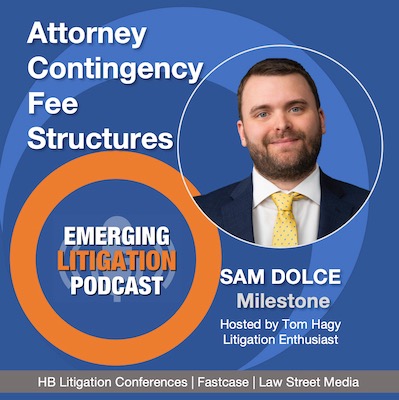
  • Attorney Fees and Settlement Funds with Sam Dolce

    Attorney Fees and Settlement Funds with Sam Dolce

    Our Guest

    Sam Dolce

    Sam DolceAttorney

    As an attorney at Milestone, Sam Dolce provides in-depth, comprehensive consultations with attorneys about qualified settlement funds, fee deferral, and settlement planning. He also oversees the establishment of QSFs.

    Sam received a Bachelor of Arts in History from Macalester College, followed by a Juris Doctor from SUNY Buffalo Law School. He served as a participant in the New York State Pro Bono Scholar Program and has received multiple acknowledgements and awards for his dedication to pro bono service and social justice. As a subject matter expert, Sam is a regular speaker and presenter at academic and legal conferences regarding post-settlement strategies.

    Attorney Fees and Settlement Funds with Sam Dolce

    Uncle Sam has created a way for you keep more of your hard-won settlement or award, but there is much to consider and new information to weigh.

    When a contingency fee case reaches a verdict or settlement, it’s a big day for a plaintiff attorney. You have worked hard and shouldered litigation costs — often for years without compensation — to achieve the best outcome for your client.

    In this episode I get to speak with a financial management professional who specializes in advising trial attorneys how they can take full advantage of attorney fee structures. The concept of fee deferral arrangements may be familiar to you, but the landscape continues to evolve.

    My guest is Sam Dolce, an attorney with Milestone, a financial firm that optimizes settlement funds for trial attorneys and plaintiffs.  Sam consults with legal professionals about about Qualified Settlement Funds, fee deferrals, and settlement planning. Sam received his B.A. from Macalester College and his J.D. from SUNY Buffalo Law School. Thanks to Sam for sharing his insights.

    On a previous episode you can hear Sam’s colleague, Erin Waas, who heads up the Milestone Foundation, a non-profit organization that provides low-cost funding to injured individuals in need of cash as their personal injury cases wind their way through court.

    This podcast is the audio companion to the Journal on Emerging Issues in Litigation. The Journal is a collaborative project between HB Litigation Conferences and the Fastcase legal research family, which includes Full Court Press, Law Street Media, and Docket Alarm. The podcast itself is a joint effort between HB and our friends at Law Street Media. If you have comments or wish to participate in one our projects please drop me a note at Editor@LitigationConferences.com.
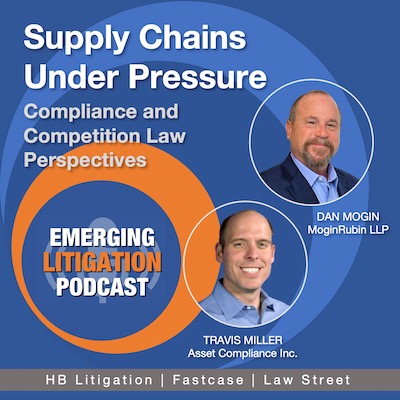
  • Under Pressure: How’s the Integrity of Your Supply Chain? — with Dan Mogin and Travis Miller

    Under Pressure: How’s the Integrity of Your Supply Chain? — with Dan Mogin and Travis Miller

    Our Guests

    Travis Miller

    Travis Miller Assent Compliance Inc.

    Travis is an international trade and compliance attorney who specializes in ITAR/EAR/sanctions, global anti-corruption and anti-slavery, codes of conduct, environmental health and safety, product stewardship, and corporate social responsibility.

    Travis manages Assent’s worldwide legal activities, advises the Board of Directors on legal matters, and oversees corporate compliance, governance initiatives, and other commercial transactions. Before coming to Assent, he served in various high-level counsel positions with companies such as Microchip Technology, Foresite Group, and St. Jude Medical.

    Dan Mogin

    Dan MoginMogin Rubin LLP

    Dan Mogin is co-founding and managing partner of MoginRubin LLP, a leading boutique law firm that focuses on antitrust law and other complex business disputes. A true thought leader in the field, Dan has served as lead counsel in numerous large antitrust cases, chaired the Antitrust Section of the California Bar, taught antitrust law, and was editor-in-chief of a leading competition law treatise.

    Under Pressure: How’s the Integrity of Your Supply Chain? — with Dan Mogin and Travis Miller

    Pressure builds when budgets are cut and fewer resources are available to maintain the necessary vigilance to remain compliant with often complex and changing regulations.

    Corporate risk can be caused by laxity, inattention, misconduct, unethical behavior, or even illegal activities by people and organizations in your supply chain. Often these things are what happen when people are under pressure. They may feel pressure to bend rules to hit sales targets, or they feel significant competitive pressure.

    Listen to my interview in two acts with Travis Miller, General Counsel at Assent Compliance Inc. and Dan Mogin is co-founding and managing partner of MoginRubin LLP, a leading boutique law firm that focuses on antitrust law and other complex business disputes. In Act 1 we discuss the conduct of a fictitious airline that is marketing itself as a green company and its competitors are crying foul, and by that I mean suing them. In Act 2 a fictitious semiconductor manufacturer that is allegedly using its considerable market power to trounce competitors. The fictitious scenarios involving these fictitious companies are as follows:

    Act 1: Greenwashing by AirGreen Corp.

    Commercial jets disproportionately spew high amounts of carbon into the atmosphere. There is no practical way to significantly reduce these harmful pollutants. Corporations are under pressure to be environmentally responsible, and demonstrate they are genuinely embracing the ESG movement. When it comes to carbon neutrality, the FTC says companies should not make “broad, unqualified” claims that they are running green businesses without “reliable scientific evidence” that their carbon offsets will have a timely impact. AirGreen, a major yet fictitious air shipping company, launched a global ad campaign called Super Green Air, dubbing itself the first commercial airline to be carbon neutral. AirGreen hasn’t actually reduced harmful emissions from its flights. Instead, it has purchased carbon offsets, which means it paid to reduce the emissions from other sources, while not actually reducing its carbon footprint. AirGreen’s competitors have filed suits and complaints with the FTC that this is false advertising that gives AirGreen a competitive edge in the air shipping market. 

    Act 2: MegaTech Monopolizing Semiconductor Chips (starts at minute 47:47)

    The global semiconductor industry makes products that run the world. They’re in PCs, large mainframes, smartphones, cable and internet equipment, electric cars, and wind turbines. The demand for silicon chips is enormous. These chips are manufactured by a dirty, environmentally unfriendly process. Their manufacture also relies on a “complex, dynamic and multidirectional global supply and services matrix” (aka supply chain). Recent clogs in that supply chain caused by the Covid pandemic and Russia’s invasion of Ukraine demonstrate that. When people think of monopolies, they think of big conglomerates that control huge markets, like AT&T and Microsoft. AT&T ruled over telephone communications without competition for years. They were “the phone company.” If you wanted assistance their number was “0.” In the case of Microsoft, it controlled more than 95% of the PC operating system market. But monopolies can also mean dominance of one specific piece of one specific product maybe even in a specific region. You could have a monopoly if you made all cell phones, or you could hold a monopoly if you make a component that makes all cellphones work. MegaTech is one such company, albeit a fictitious one. It makes the chip that makes your cable box work. In fact, they are the only maker of these chips. MegaTech has already been investigated and sued by the FTC. It has already agreed to stop anticompetitive conduct such as exclusivity arrangements with its customers. And, it has already broken that promise and is being investigated again. Some of its suppliers are considering major litigation, too.

    We discuss these scenarios from the perspectives of in-house compliance and legal professionals, outside counsel specializing in competition law, and a journalist covering the legal industry.

    This podcast is the audio companion to the Journal on Emerging Issues in Litigation. The Journal is a collaborative project between HB Litigation Conferences and the Fastcase legal research family, which includes Full Court Press, Law Street Media, and Docket Alarm. The podcast itself is a joint effort between HB and our friends at Law Street Media. If you have comments or wish to participate in one our projects please drop me a note at Editor@LitigationConferences.com.
    Tom Hagy
    Litigation Enthusiast and
    Host of the Emerging Litigation Podcast

    p.s. I add brief insights, humbly, on behalf of the Fourth Estate. In so doing, I also demonstrate why — if you’re no good at multitasking —  don’t. Especially around smart people who are really paying attention.  Also, if at some point you think you hear birds chirping, it might be time to see someone. Special thanks to our sound engineer, Jordan Forbes.

  • The “Ending Forced Arbitration of Sexual Assault and Sexual Harassment Act of 2021” Finally Levels the Playing Field by Kathryn Hatfield

    The “Ending Forced Arbitration of Sexual Assault and Sexual Harassment Act of 2021” Finally Levels the Playing Field by Kathryn Hatfield

    The Author

    Kathryn Hatfield

    Kathryn HatfieldHatfield | Schwartz Law Group

    Kathryn V. Hatfield (khatfield@hatfieldschwartzlaw.com) is a
    partner in the women-owned law firm of Hatfield Schwartz Law Group
    LLC where she focuses on advising and representing management in
    labor and employment law matters. Kathryn is a member of the Editorial Advisory Board for the Journal of Emerging Issues in Litigation.

    The Journal on Emerging Issues in Litigation

    Emerging Litigation Podcast

    Emerging Litigation PodcastProduced by HB Litigation and Law Street Media

    Interviews with leading attorneys and other subject matter experts on new twists in the law and how the law is responding to new twists in the world.

    The “Ending Forced Arbitration of Sexual Assault and Sexual Harassment Act of 2021” Finally Levels the Playing Field

    “While arbitration offers privacy and confidentiality, it is for exactly these reasons that the #MeToo movement developed. Moreover, other than perhaps the differences in the speed of the two processes, the advantages of arbitration can be flipped on their head and become disadvantages.”

    Abstract: The Equal Employment Opportunity Center alone receives on average approximately 7,000 sexual harassment claims a year, a figure that does not include claims filed with state and local agencies. The cost of resolving these claims logged by the EEOC averages $63 million a year based on the past four years. On average, there are nearly 464,000 victims (age 12 or older) of rape and sexual assault in the United States each year. The Centers for Disease Control and Prevention reports that nearly 1 in 5 women in America experiences a rape or attempted rape, and nearly 44 percent of women and about 25 percent of all men experience some form of sexual violence in their lifetime. A White House statement called sexual assault a “public health crisis.” But victims of sexual harassment and assault in the workplace have not had open access to the courts due to mandatory arbitration clauses in their employment agreements. In this article, an experienced labor law attorney discusses a new law that puts an end to forced arbitration, what it means to existing claims, and its impact on victims, employees, and employers. 

    Introduction

    The Act adds a new section to the Federal Arbitration Act (FAA). The FAA was passed in 1925 to ensure that courts enforce arbitration agreements contained in “a contract evidencing a transaction involving commerce.” See 9 U.S.C. § 2. Although the FAA was intended to address maritime and commercial disputes, in a series of decisions beginning in the 1980s, the United States Supreme Court “dramatically expanded the applicability of the FAA to arbitration clauses in everyday contracts.” See House Judiciary Committee Report.

    According to that Report, the Supreme Court “has upheld the enforcement of arbitration clauses even when doing so prevents an individual from vindicating a state or federal statutory right. Furthermore, by imposing arbitration on a ‘take it or leave it’ basis, large companies have largely eviscerated the congressional intent of arbitration as a voluntary process agreed to between parties of equal bargaining power.” Id. Ultimately, in 1991, the Supreme Court ruled that an employee whose employment contract contained an arbitration provision was required to arbitrate her claims, thus bringing arbitration mandates into the workplace. See Gilmer v. Interstate/ Johnson Lane, 500 U.S. 20 (1991). Twenty years later, the Supreme Court expanded its jurisprudence on forced arbitration in AT&T Mobility LLC v. Concepcion, 563 U.S. 333 (2011), and American Express Co. v. Italian Colors Restaurant, 570 U.S. 228 (2013), holding that class action waivers in mandatory arbitration agreements were broadly enforceable. The combination of this case law ensured that employers could now protect themselves from court litigation for both individual and class action claims.

    Arbitration requirements are now widespread in consumer contracts and, often, consumers are unaware that they are entering into forced arbitration agreements. Most arbitration clauses are found in application forms, employment contracts, employee handbooks, privacy policies, and even monthly billing statements. The House Judiciary Report noted that these clauses are hidden in order to prevent consumers from pursuing their claims in court and gave an example highlighting the inequity of forced arbitration. In that case, Massage Envy, the largest massage chain in the country, compelled victims of sexual assault to arbitrate their claims and refused to allow women to cancel their monthly membership unless they agreed to forced arbitration …. keep reading!

    Download the article now!

  • Alternative Financial Support for Plaintiffs During Litigation with Erin Waas

    Alternative Financial Support for Plaintiffs During Litigation with Erin Waas

    Our Guest

    Erin Waas

    Erin WaasThe Milestone Foundation

    Erin Waas is Executive Director of The Milestone Foundation, a national 501(c)(3) nonprofit that provides financial assistance to people pursuing a personal injury lawsuit. Erin brings nearly two decades of experience working in the public sector and with nonprofits in fundraising and communications, most recently at the University at Buffalo, where she served as senior advancement writer.

    Prior to relocating to Buffalo, Erin spent the bulk of her career to-date in Boston, where she worked in stewardship at Harvard University and as a consultant for nonprofits of all sizes.

    Alternative Financial Support for Plaintiffs During Litigation with Erin Waas

    For an individual, merely navigating litigation can be expensive, time consuming, and at times overwhelming. But when that individual is also unable to work, or cannot function normally  because they have been disabled by an injury, that explodes the level of stress on a person and their family.

    There are companies in the “non-recourse settlement advancement” space that will provide financial support to claimants in litigation. This helps them with their regular daily expenses – plus medical costs – until their case settles or until they receive an award. But most of these companies, as you can imagine, are for-profit entities. As such, their fees can make their support unaffordable and can leave the plaintiff with a substantially diminished payout.

    Listen to my interview with Erin Waas, Executive Director of The Milestone Foundation, a national 501(c)(3) nonprofit that provides financial assistance to people pursuing a personal injury lawsuit. Erin brings nearly two decades of experience working in the public sector and with nonprofits in fundraising and communications, most recently at the University at Buffalo, where she served as senior advancement writer. Prior to relocating to Buffalo, Erin spent the bulk of her career to-date in Boston, where she worked in stewardship at Harvard University and as a consultant for nonprofits of all sizes.  Speaking of fundraising, and if you believe in the cause, consider supporting the Foundation with a donation today.

    This podcast is the audio companion to the Journal on Emerging Issues in Litigation. The Journal is a collaborative project between HB Litigation Conferences and the Fastcase legal research family, which includes Full Court Press, Law Street Media, and Docket Alarm. The podcast itself is a joint effort between HB and our friends at Law Street Media. If you have comments or wish to participate in one our projects please drop me a note at Editor@LitigationConferences.com.

    Tom Hagy
    Host
    Emerging Litigation Podcast

  • Antiracism and Antitrust with Eric Cramer

    Antiracism and Antitrust with Eric Cramer

    Our Guest

    Eric L. Cramer

    Eric L. CramerBerger | Montague

    Eric Cramer is Chairman of the Firm and Co-Chair of the Firm’s antitrust department. He has a national practice in the field of complex litigation, primarily in the area of antitrust class actions. He is currently co-lead counsel in multiple significant antitrust class actions across the country in a variety of industries and is responsible for winning numerous significant settlements for his clients totaling well over $3 billion.

    Mr. Cramer is also a frequent speaker at antitrust and litigation related conferences and a leader of multiple non-profit advocacy groups. He was the only Plaintiffs’ lawyer selected to serve on the American Bar Association’s Antitrust Section Transition Report Task Force delivered to the incoming Obama Administration in 2012.

    Antiracism and Antitrust with Eric Cramer

    Among the legal and regulatory avenues one might follow to mitigate the impact of racism, most of us would look to various manifestations of discrimination law in  employment, lending, real estate, education, healthcare, voting rights, and other categories. When presented in those contexts, the anti-racism objectives are clear. 

    There are several federal laws and many state laws that prohibit anticompetitive behavior.  At the top of the heap is the Sherman Antirust Act of 1890, which outlaws illegal monopolies and anticompetitive tactics, conspiracies to restrain trade, cartels and syndicates.  But what do wages, including those paid to minorities, have to do with antitrust? What about no-poach agreements, whereby groups of companies agree not to hire employees away from each other?  The answer is “quite a lot.”

    Listen to my interview with Eric Cramer, Chairman of Berger Montague and co-chair of the firm’s antitrust department, a team that handles antitrust class actions across the country involving a variety of industries.  Eric and the firm are responsible for winning numerous significant settlements for clients — a total value that now exceeds $3 billion. His recent focus has been representing workers who allege their employers’ anticompetitive practices  suppressed their pay. Recipient of numerous accolades and awards that include terms like titan, elite, thought leader, visionary, and lawyer of the year, Eric is a summa cum laude graduate of Princeton University where he earned membership in Phi Beta Kappa, and a cum laude graduate of Harvard Law School. Listen to what he had to say about this important subject.

    This podcast is the audio companion to the Journal on Emerging Issues in Litigation. The Journal is a collaborative project between HB Litigation Conferences and the Fastcase legal research family, which includes Full Court Press, Law Street Media, and Docket Alarm. The podcast itself is a joint effort between HB and our friends at Law Street Media. If you have comments or wish to participate in one our projects please drop me a note at Editor@LitigationConferences.com.
    Tom Hagy
    Litigation Enthusiast and
    Host of the Emerging Litigation Podcast

  • Wildfire Claims and Coverage

    Wildfire Claims and Coverage

    The Authors

    Scott DeVries

    Scott DeVriesHunton Andrews Kurth LLP

    Scott P. DeVries (sdevries@huntonak.com) is a special counsel
    in the Hunton Andrews Kurth LLP’s Insurance Coverage group in the
    firm’s San Francisco office where he exclusively represents policyholder
    clients. An experienced trial and appellate lawyer who has served as lead
    counsel in landmark appeals in the field of insurance coverage in the
    California Supreme Court, the Ninth Circuit, and the California Court
    of Appeal, as well as high-value jury trials, Scott routinely represents
    clients throughout the country seeking recovery from their insurers
    on a wide range of insurance issues arising under first-party property
    policies, comprehensive general liability policies, directors and officers
    policies, EPLI policies, crime policies, crypto and digital asset policies,
    and cyber policies.

    Yosef Itkin

    Yosef ItkinHunton Andrews Kurth LLP

    Yosef Itkin is an associate in Hunton Andrews Kurth LLP’s Insurance Coverage group in the firm’s Los Angeles office. His practice focuses on representing and advising
    corporate policyholders in complex insurance coverage matters.

    The Journal on Emerging Issues in Litigation

    Emerging Litigation Podcast

    Emerging Litigation PodcastProduced by HB Litigation and Law Street Media

    Interviews with leading attorneys and other subject matter experts on new twists in the law and how the law is responding to new twists in the world.

    Wildfire Claims and Coverage

    “The wildfires are causing enormous losses for innumerable businesses on the West Coast. Often, you should be able to work with your adjuster to reach a satisfactory resolution. But where needed, you may wish to reach out to policyholder-side lawyers—whether to test what you may be entitled to or to help maximize recovery.”

    Abstract: Wildfires destroy millions of acres a year in the United States, spewing smoke across much of the nation. The cost of damage alone over the past several years soars into the hundreds of billions. When policyholders turn to their insurers many benefit from the coverage they wisely secured. But not all policyholders get the coverage they believe they paid for. When and how they present their claims is a critical factor. In this article, the authors strive to provide a comprehensive understanding of coverage risks, the regulatory landscape, and navigating the all-important claims process. 

    Sparked by lightning storms, devastating wildfires claimed more than 10 million acres in 2020, releasing substantial amounts of smoke above the western United States. Accuweather founder and CEO Dr. Joel N. Myers called 2020 “the worst fire season in history,” and estimated that the total damage and economic loss would be between $130 billion and $150 billion. And 2021 was not any better. According to the Insurance Information Institute, in 2021, while the hottest temperatures on record were recorded in California, Nevada, Oregon, Washington, and Arizona, and drought conditions reached an all-time high, the number of wildfires remained approximately the same (58,900) although the number of acres destroyed reduced to 7.1 million acres from the year before. Some of the wildfires were among the largest on record with the Bootleg Fire in Oregon destroying 400,000 acres and the Marshall Fire in Colorado causing an estimated $1 billion in losses.

    Fortunately, many individuals and businesses are fully insured, and most insurance companies work with policyholders to process claims and help them rebuild and get them back up and running. However, it does not always work that way for every insured. While property insurance may cover much of the losses from wildfires and other catastrophic events, not every policyholder is made whole or anything approaching this. And even for those that are fully insured, when and how to present a claim can materially affect how much they recover and when. This can be extraordinarily difficult at any time, but especially when a fire has destroyed everything.

    Download the article now!