Category: Mass Torts

  • Attorney General Ferguson of Washington Sues State’s Top Opioid Distributers

    “We are woefully under-resourced when it comes to treatment. The people who are responsible for this epidemic should being paying for it. We are going to hold these companies accountable and get more money into our communities for treatment.” –Washington AG Bob Ferguson

    The three largest distributors of prescription opioids in Washington State are being sued by Attorney General Bob Ferguson for fueling the state’s opioid epidemic. Detailed in Ferguson’s King County lawsuit are the billions of dollars made from these suspicious shipments of over 2 billion pills of unregulated oxycodone, fentanyl, hydrocodone and other opioids.

    “Prescriptions and sales of opioids in Washington skyrocketed more than 500 percent between 1997 and 2011. In 2011, at the peak of overall sales in Washington, more than 112 million daily doses of all prescription opioids were dispensed in the state — enough for a 16-day supply for every woman, man and child in Washington,” according to the AG’s announcement.

    “In 2014 McKesson, Cardinal Health and AmerisourceBergen shipped enough opioids to Pend Orielle County to supply every single resident with dozens of pills. In 2009, McKesson alone supplied enough for dozens of pills for every resident of the county. The specific shipment numbers are currently under seal.”

    County Prescription Rates Map

    The accused distributors are in the top 15 Fortune 500 list based on 2017 revenue. In addition to the lawsuit, the distributors owe millions of dollars in fines, and must surrender the profits, the state maintains. “The surrendered profits will be used to remediate the effects of the opioid epidemic, possibly funding treatment, education and more.”

    In September of 2017, Ferguson sued one of the nation’s largest opioid manufacturers, Purdue Pharma, accusing the OxyContin maker of “fueling the state’s opioid epidemic by embarking on a massive deceptive marketing campaign and convincing doctors and the public that their drugs are effective for treating chronic pain and have a low risk of addiction, contrary to overwhelming evidence.”  In April  2018 a King County judge denied Purdue’s attempt to dismiss Ferguson’s lawsuit. State medical boards have since implemented opioid prescription limits.  Read the Washington State Attorney General’s Press Release here.

  • Foggan & Huggins on Opioid Litigation Defense Coverage

    Is a drug company that’s sued in connection with the manufacture, promotion and distribution of opioids covered by its insurer for defense costs?

    According to Laura A. Foggan and Michael Lee Huggins of Crowell & Moring, LLP, that determination will come down to whether, in the relevant state, an accident takes place when either the act or the injury was unintentional, or whether an accident occurred if only the act was unintentional.

    This definition will vary by state, Foggan and Huggins wrote in California Litigation, published by the Litigation Section of the California Bar earlier this year.

    South Carolina may permit coverage if “either the act or the injury was unintentional,” they explained. In Liberty Mutual v. J.M. Smith, the Fourth Circuit held that if a drug company failed to identify and alert regulatory agencies of suspicious drug orders, then there may be a duty to defend.

    But in California, the Crowell & Moring attorneys wrote, with that state’s definition of “accident” a state appellate court in Travelers v. Actavis held that a “deliberate act is not an accident, even if the injury is unintentional, unless the injury was produced by an additional, unexpected, independent, and unforeseen happening.”

    In that case drug company Actavis allegedly engaged in deceptive marketing in order to sell more opioids and reap more profits. According to Foggan and Huggins, the court said such alleged conduct can only be described as deliberate and intentional. Whether the company intended to injure anyone is irrelevant in determining coverage, the court determined.

    “[T]he court concluded that none of the alleged injuries — including the flood of opioids into the American medical market, the opioid epidemic, the resurgence in heroin use, or the increased public healthcare costs resulting from long-term opioid use — was an ‘additional, unexpected, independent, or unforeseen’ event that would support a duty to defend,” the attorneys wrote. For these reasons the California appeals court found there was no possibility of defense coverage under a CGL policy.

    The latest is that the California Supreme Court granted review of Travelers v. Actavis but deferred briefing until there is a ruling on the definition of “occurrence” in another case, Liberty Surplus v. Ledesma & Meyer.

    Foggan and Huggins also discussed issues such as “relief sought ‘for’ or ‘because of’ bodily injury,” products exclusions, and a number of untested coverage issues, such as whether opioid injuries constitute a continuous trigger of coverage or how the role a defendant played in the opioid market impacts coverage.

    The complete article will be included with the handouts accompanying our Dec. 4, 2018, CLE webinar. Laura will be joined by policyholder counsel Bernard Bell of Miller Friel PLLC. 

  • Complex Post-Settlement Liens | CLE Course | Recorded July 26, 2018


    [two-fifths-first]

    Two ways to access this session.

    Get it direct from HB for just $197 for the video — audio synced with slides.

    Or, it’s included in your West LegalEdcenter (Thomson Reuters) subscription.

    ____________________


    Speakers

    Franklin Solomon
    Solomon Law Firm

    Brett Newman
    Lien Resolution Group

    [/two-fifths-first] [three-fifths]

    Complex Post-Settlement Liens:

    Beyond Traditional Medicare and Medicaid Issues

    Take this highly practical course with two deeply experienced practitioners who share insights on issues that impact the cases on your desk today.

    Learn about the newest case law, agency positions and litigation tactics affecting health and disability plan reimbursement claims, including how to protect your clients and your practice in this rapidly developing area.

    Our speakers discuss:

    Medicare Advantage Plans

    Federal Employees Health Benefits Act (FEHBA) Plans

    Employee Retirement Income Security Act (ERISA) Claims

    Medicare set-asides

    TRICARE

    Veterans Administration Claims


    Speaker Bios

    Franklin P. Solomon | Solomon Law Firm

    Franklin Solomon has a nationwide practice focused on evaluation, litigation and resolution of healthcare lien/reimbursement claims. He represents personal injury victims and their attorneys in defending against claims by health plans and government benefits programs seeking payment out of tort recoveries. Most recently, he was plaintiffs’ counsel in two federal appellate court cases decided last summer: Wurtz v. The Rawlings Company, ___ F.3d ___, (2d Cir. 2014), a class action challenging New York insurers’ reimbursement claims against their insureds, and Taransky v. Sec. U.S. Dept. of Health & Human Svcs., ___ F.3d ___ (3d Cir. 2014), a class action challenging Medicare’s claims for reimbursement out of New Jersey tort recoveries.

    Brett Newman | The Lien Resolution Group

    Brett Newman is known nationally by plaintiff attorneys for his expertise on claims avoidance and reduction. Recognizing the ever-growing nature of lien resolution and the ever-increasing associated liability, Brett established The Lien Resolution Group and The Newman Structured Settlement Group to assist both individual claimants of personal injury lawsuits and mass tort claimants in the protection of their proceeds and government benefits.

    [/three-fifths]

  • HB Announces Alliance with Alliance of Women Trial Lawyers

    We are proud to announce our latest alliance with a new trial attorneys group just for women on the plaintiff side of tort litigation.

    Founded by plaintiff law conference veteran Nancy Holston, the Alliance of Women Trial Lawyers is committed to empowering these professionals, helping them to overcome “systematic obstacles and to realize greater self-sufficiency and wholeness through support, acknowledgement and utilization of dormant, yet innate strengths.” Before founding the Alliance in July 2018, Nancy was a principal at 360 Advocacy and before that the first Executive Director of Mass Torts Made Perfect.  Nancy is well-connected in the plaintiff bar and is excited by the initial reaction to her new venture.

    Nancy is equally inspired by the feedback she is getting for the Alliance’s first national conference which will be held from Saturday, Oct. 27th through Monday, Oct. 29 at the Ritz-Carlton in New Orleans. The program features many of the leading women trial attorneys in the country and a range of topics on practice development, litigation strategy, preparing witnesses, jury selection, deposition skills, direct examination, opening arguments and ethical issues involved in settlements. 

    “I admire anyone who takes a risk to do something they believe in, and Nancy has demonstrated both enthusiasm and commitment to improving the professional lives — and personal lives, for that matter — of women who represent plaintiffs in mass torts,” said Tom Hagy of HB Litigation Conferences. “It’s an important mission and we’re excited to lend our support.”

    “We look forward to working together to grow our respective portfolios and educate attorneys on important and emerging legal issues. There is an outside chance we will also have some fun along the way,” Tom added.

    Click here for more information about the AWTL’s 2018 Fall Conference. 

  • Right to Try Act: Commentary Roundup


    A Life Saver, Political Grandstand, or Harmful Scam?

    Depends on Who You Ask. And When.

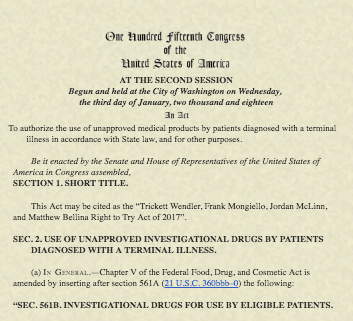
    It’s been two months since President Donald J. Trump signed into law the Right to Try Act which allows terminally ill patients access to experimental drugs not yet approved by the FDA. Like many things in America in 2018, opinions on the efficacy of this new law vary along party or ideological lines. Will it give hope and precious life-extending solutions for patients fighting terminal disease? Or is it a money-driven scheme intended to enrich corporations and the super rich? Signed into law on May 24, 2018, is it something that can be implemented effectively? Here are a few quotes that explain the controversy.

    Additional commentary or insights welcome.
    Send yours to Editor@LitigationConferences.com.

    “Timely access to promising treatments in … devastating circumstances.”

    “This new law amends the Federal Food, Drug, and Cosmetic Act to establish a new pathway aimed at increasing access to unapproved, investigational treatments for patients diagnosed with life-threatening diseases or conditions who have exhausted approved treatment options and who are unable to participate in a clinical trial. Our implementation of the Right to Try Act will build on our long-standing efforts to help patients and families who are facing life-threatening diseases or conditions, in a way that seeks to protect their autonomy, their safety, and the safety of others following in their paths.”

    “The decisions we reach related to products that can serve as an effective treatment for a terminal illness, or that can arrest a devastating and debilitating condition, are among the most important and carefully considered judgments that we make. We recognize the important balance between making sure patients have the assurances Congress intends, while enabling timely access to promising treatments in these devastating circumstances. And we’ll implement this new law consistent with these longstanding values.”

    FDA Commissioner Scott Gottlieb

    “GOP senator reveals the truth: Right-to-try bill was a scam tailored to harm public health”

    “Anyone with a smidgen of knowledge about healthcare understood that the right-to-try legislation signed by President Trump on Wednesday was a scam, perpetrated by the Koch brothers and their henchmen.”

    “Masquerading as a “compassionate” measure aimed at providing victims of terminal diseases with a last bit of hope that an experimental treatment might save them, it really was aimed at undermining the authority of the Food and Drug Administration to make sure our drugs are safe and effective.”

    Read the full article in the Los Angeles Times.

    “We remain skeptical about whether right-to-try statutes actually help anyone …

    … as opposed to being political grandstanding.  That said, from the perspective of attorneys representing pharmaceutical companies, this bill is about as good as it could be, and – to the extent that it extends preemption to the compassionate use program – it even marginally improves current law.”

    Read the full commentary written by James M. Beck of Reed Smith on the Drug & Device Law Blog. 

    Note: Beck’s commentary was written in March 2018.

    “Very little change for most patients …”

    “Despite these state gains and the policy’s growing popularity among states, ethical questions remain about the tangible impact of a federal right to try law on Americans with terminal illnesses. Most notably, a growing body of evidence from policy analysts argues that the legislation would unfortunately accomplish very little change for most patients, and it could actually make it harder to get new drugs approved in the future.”

    Written for CBS.com by Morten Wendelbo, a lecturer at the Bush School of Government and Public Service and a research fellow at the Scowcroft Institute of International Affairs at Texas A&M University, and Timothy Callaghan, assistant professor at Texas A&M University Health Science Center. Read the complete commentary. 


    Additional commentary or insights welcome.

    Send yours to Editor@LitigationConferences.com.

    This controversial topic will be on the agenda at the Drug & Device Defense Forum in New York Oct. 15, 2018.

  • Class Actions Weekly Roundup from Top Class Actions

    This roundup is prepared exclusively for HB Litigation Conferences by:


    Walmart Class Action Claims Glucosamine Tablets are Mislabeled

    Walmart has been hit with a class action lawsuit claiming that their store brand glucosamine tablets are mislabeled. Plaintiffs Cynthia Parker, Reba Garth, Margaret Herrin, and Shirley Reinhard allege that Walmart misrepresents its store-brand glucosamine sulfate dietary… Read More

    Sorin 3T Heater Cooler Lawsuit Alleges Serious M. Chimaera Bacterial Infection

    An Indiana man has filed a Sorin 3T heater cooler lawsuit against LivaNova PLC, alleging their cardiac heater cooler device had caused him to develop a potentially fatal infection. The claimant filed the Sorin 3T heater cooler… Read More

    Coca-Cola Seeks Dismissal of Diet Coke Class Action Lawsuit

    Coca-Cola asked a New York federal court to toss a class action lawsuit alleging the company’s use of the name “Diet Coke” is misleading. The company argues that claims against its use of the word “diet” in… Read More

    Couple Files Stryker Hip Recall Lawsuit Over Metallosis Complications

    Thousands of hip implants were affected by a Stryker hip recall after they were linked with serious complications, including metallosis. Some patients affected by these major side effects have turned to litigation, hoping to regain some… Read More

    Facebook Class Action Challenges Facial Recognition Technology

    Facebook faces a new class action lawsuit alleging that the social media site captured and stored biometric information of non-users in violation of Illinois state law. Plaintiff Clayton Zellmer argues that Facebook broke state law by… Read More

    Woman Alleges Bleeding While Taking Xarelto in Lawsuit Against Drug Makers

    A woman who allegedly suffered bleeding while taking Xarelto has filed a lawsuit against the makers of the anticoagulant drug. Plaintiff Emmy L. filed the Xarelto lawsuit in Louisiana federal court, joining a growing multidistrict litigation (MDL) against… Read More

    Arthrex Knee Replacement Causes Injuries, Patients Claim

    Knee replacement surgery is one of the most common surgical procedures in the U.S., but some patients who have received a knee device like the Arthrex knee replacement alleged that they suffered serious complications. In some cases, Arthrex… Read More

    United Industries Can’t Escape Spectracide False Ad Class Action Lawsuit

    Last week, a California federal judge denied a bid by herbicide maker United Industries Corp. to dismiss a false advertising class action lawsuit after finding it possible that reasonable consumers would be misled by the labeling… Read More

  • Top Class Actions’ Top Trends Affecting Class Actions in 2018

    Editor’s Note: This article was written by Kim Gale at Top Class Actions and is reprinted here with the permission of the publisher. Scott Hardy, the company’s President & CEO, is one of the speakers featured at HB’s Class Action Mastery conference May 9-11, 2018 in New York. Top Class Actions is sponsoring that event and its companion program, Mass Tort Med School, the same week. 

    As we come close to rounding out the first quarter of 2018, it is clear that several class action lawsuit trends from 2017 will continue to ripple through the court system this year.

    Class Action Lawsuit Stats
    Did you know three areas are responsible for a third of all class action lawsuits filed in the U.S.? The federal courts in California, Southern District (Miami) of Florida, and the Eastern District (Brooklyn) of New York keep lawyers and judges the busiest.

    In the initial nine months of 2017, a total 3,136 federal class action lawsuits were filed in those areas alone, according to an article published Dec. 9, 2017 by PorterWright.com.

    These statistics are apt to change because new Supreme Court decisions (Bristol-Myers Squibb v. Superior Court of California and BNSF Railway Co. v. Tyrrell) rein in a court’s jurisdiction and ability to litigate matters when residents from outside the court’s state make claims.

    These new decisions mean a defendant will need to be sued in the state where the business is incorporated. Another option could be for individual states to file class action lawsuits and then seek to have them consolidated through multidistrict litigation (MDL).

    Marketing Tactics Under Fire
    Makers of everything from washing machines to mascara faced allegations of product misrepresentation. Advertising claims such as “organic,” “preservative free” and “virgin” can land a company in hot water with multiple class action lawsuits if these claims can be proven false.

    In 2017, class action lawsuits started challenging the way some products are made because consumers possibly paid more for such proclamations.

    For example, extra virgin olive oil is the highest quality available, which consumers often pay a premium to receive.

    To earn the title extra virgin, the oil must be free of defects, taste like fresh olives, and be produced using no solvents. Extra virgin olive oil has to be manufactured by a mechanical process and in temperatures that will not allow the oil to degrade. Finally, the oil must be sold in darkly tinted bottles to keep the product from degrading on the shelf.

    In one olive oil case that led to a class action settlement (Kumar v. Safeway Inc.), olive oil labeled extra virgin was allegedly mixed with refined oil and packaged in clear bottles, ruining any chance at truly being “extra virgin.” To add further insult, the olive oil was labeled as imported from Italy, but contained olive oil from a variety of other countries not particularly known for their brilliantly tasty olives.

    Consumers do not take kindly to paying a premium for false enhancements, which has led to multiple class action lawsuits against companies that tout their product as better than the rest due to refinements that don’t exist.

    Class Action Settlements Under Scrutiny
    In 2013, Subway was hit with a class action lawsuit after a foot-long sandwich that fell short at 11 inches was posted on social media. Subway explained away the one-inch discrepancy by saying the dough is a foot long, but after the bread is baked, the natural action of the dough rising can cause impact on the length.

    A class action settlement was reached in 2015 in which Subway agreed to make sure all locations adopted a uniform practice to guarantee each unbaked loaf measured 12 inches.

    In the settlement, Subway also agreed to pay the class counsel’s $520,000 fees but offered no monetary compensation to consumers.

    In September 2017, the 7th Circuit Court in Chicago reversed the Subway settlement on appeal because consumers would see the settlement as “utterly worthless.” The court expressed disgust over the settlement terms, indicating that any settlement that pays the class counsel, but provides no relief to the Class Members, “is no better than a racket.”

    The court’s reversal of the settlement will force future defendants to make sure any settlement offer they consider includes a true benefit to Class Members and not just to their counsel.

    Opioid Manufacturer Litigation
    In 2017, more than 100 cases were filed against opioid manufacturers by individuals, health insurance companies, state governments, county governments and city governments. These opioid lawsuits seek to hold manufacturers accountable for the epidemic of opioids in the country that have led to overworked and under-financed ambulance services, hospital services, EMTs, police officers, rehabilitation facilities and other providers of care to people who overdose on opioids and need life-saving intervention.

    The judicial panel on multidistrict legislation is considering motions to centralize these pending lawsuits. Whether or not the cases are processed separately or as an MDL, outcomes from these opioid epidemic cases will set new precedents, affecting the medical community and the law.

    “Small” Data Breach Litigation
    Even though high-profile data breach cases make the news, many smaller data breach class action lawsuits are filed every day. Large and small businesses collect data on customers and employees. Disgruntled current or former employees can cause big headaches by allowing a small data breach.

    Employees who aren’t particularly computer savvy can accidentally save sensitive information where hackers could access it. As technology to enhance computer security has advanced, so have the skills of potential hackers who constantly look for weaknesses in firewalls.

    A Look Forward
    In 2018, class action lawsuits will continue to address claims regarding baby powder cancer, Roundup cancer, medication dangers, airbag recalls, whistleblower cases and other consumer-related issues.

    © Copyright 2018 Top Class Actions